




Intro
When Dylan MacManus signed with Stiff Records, he was pressured to pick a stage name. He went with "Elvis" almost as a joke, but "Costello" was his dad's stage name (music runs in his family). Then just weeks after Costello's debut came Elvis Presley's unexpected death. Unintentionally, "Elvis" represented a passing of the music torch from oldies to new wave. Let's unpack what this second Elvis was about. The anger. The '50s stylings. But also: Costello's songs rarely mean exactly what they seem to mean at first listen. Upbeat arrangements hide biting satire, and apparent love songs reveal darker emotional undercurrents. While he has great songs throughout his career, his first three albums set the blueprint.
Angry Young Man (In a Way)
Costello's 1977 debut My Aim is True is a new wave and rock classic: it quickly established him in the "Angry Young Man" camp, soon joined by Joe Jackson. Sure, contemporaries like the Sex Pistols one-upped him in anger, but Costello did it so much smarter, injecting wit and irony, and rarely veering into nihilism. The result is an angry man you can commiserate and sympathize for, thank you very much.
Watching the Detectives
Costello's debut had some aggressive rockers. Watching the Detectives swaps Costello's debut's punchy rock for a slinky reggae groove while a woman watches TV. To add tension and paranoia reminiscent of a detective TV show, this groove is punctuated by sudden rapid snare-roll fills. That's another nod to the Jamaican rhythms Costello was borrowing from. What's so angry about all that? Well, Costello delivers a scathing commentary on how people become emotionally detached when watching TV. An especially telling line is "she's filing her nails while they're dragging the lake". In fact, she's so glued to the TV that she doesn't notice Costello himself was watching her the whole time! And it certainly wouldn't be the last time Costello fooled some of his listeners.
Pump it Up
The following year, Costello released This Year's Model (pun intended). Just ten seconds in, you're confronted with one of the most aggressive Farfisa organ riffs I've heard. And it's easy to see Costello banging it while belting this number. The lead guitar serves as the organ's sidekick in the pummeling, joining at the end of the choruses. On the surface it sounds like a lively rally cry, but the anger is hinted at with the follow up to "pump it up" - "you don't really need it". Dig deeper, and Costello is criticizing addiction culture. Drugs and alcohol are the usual suspects, but Costello makes the lyrics vague enough that it could be applied to anything that could give you a dopamine hit.
My best-of-1978 bit on Pump it Up.
 Preview Elvis Costello
Pop Traditionalist (In New Wave Clothing)
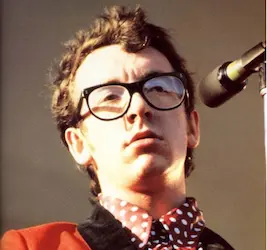
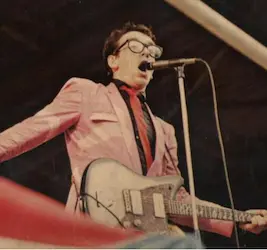
Costello had a distinct stage persona, invoking the late Buddy Holly's thick glasses and smart suits. And it wasn't just for show: he adopted the oldies' penchant for economical song lengths and Farfisa organs. Indeed, he borrowed heavily from the entire early rock playbook.
Alison
Off the debut alongside the acidic Watching the Detectives, Alison is a great showcase of Costello applying the '50s music techniques he loved. Channeling Buddy Holly, Costello pivots to simple chord progression, and restrained '50's-style crooning. But it's not a straight up '50s-pastiche - Costello maintains an edge in his vocals, and the lyrics are darker and more complex. In it, Costello and Alison used to go out. Years later, he realizes she's had it really rough after him. Costello's reaction is affection, bitterness, jealousy, and regret all rolled into one. It's a perfect example of Costello's signature trick: disguising emotional complexity inside what initially sounds like a simple love song.
Radio Radio
In his follow-up This Year's Model, Costello gives more '50s stylings with Radio Radio. The Farfisa organs are a bit more melodic than in Pump it Up, and the chugging bass guitar give Radio Radio an upbeat sound. Because of this and the line "a sound salvation", it seems like an ode to the radio. But suspicious minds soon realized otherwise. Costello makes you question his earlier praise with "radio is cleaning up the nation", and then damns radio as a control mechanism with "they don't give you any choice". While Costello owed a lot to radio, their censorship and play-it-safe mentality also angered him. He says "I wanna bite the hand that feeds me". "So badly", in fact.Preview Elvis CostelloThe Persona Peaks
On his third album Armed Forces, Costello begins smoothing those rough edges into fuller pop arrangements, adding hooks and piano-driven melodies that sometimes recall the craftsmanship of Squeeze (whom he would soon produce). Costello's vocal style also evolved. Early on he barked and sneered through lyrics, emphasizes key syllables. With Armed Forces and beyond his vocals are smoothed slightly into melodic phrasing. Compared with Squeeze's Glenn Tilbrook - whose vocals glide politely across their melodies - Costello still sounds impatient. But not quite like Men Without Hats' Ivan Doroschuk, whose intentionally jarring delivery borders on theatrical. Costello lands in the middle. This growing versatility sets him up nicely for a long, successful career, never having to leave the building. If you dig his melodic hits Everyday I Write the Book and Veronica, it started here.
Oliver's Army
Oliver's Army is a great example of Costello's music smoothing out - with flowing piano chord progressions and gentler guitars. Musically, the track leans heavily on bright piano chords and a cheerful rhythm. But the marching quality of this rhythm, along with the song title, suggest Costello is going to critique Britain's military-colonial complex.
In Oliver's Army and other tracks on Armed Forces, his vocals are smoothed slightly into melodic phrasing. But make no mistake: he's still angry. It's just that he's turning it from personal vitriol to macro issues like the British military. The line "if you're out of luck or out of work, we could send you to Johannesburg" highlights the poor British economy of the late '70s, and the government capitalizing on this desperation by recruiting young men for war.
Accidents Will Happen
Accidents Will Happen sonically takes a similar approach to Oliver's Army, the guitars are smooth and the piano flourishes instead of hammers. This contrasts with Pump it Up. But Costello's traditional core is still present. Like Watching the Detectives, Costello uses graphic metaphors like a "hit and run" and "you used to be a victim now" for a more benign phenomenon: in this case, the subject's entangled romances. But actually she's sent many men to the heartbreak hotel, only to find it in there now herself. Costello's irony is in full fore here, with lyrics and his cool, detached tone suggesting these romantic disasters were not accidents but quite predictable. As for his vocal delivery, Accidents shows the balance he'd found by 1979: still sharp and sarcastic, but now sliding more comfortably across the melody.
Preview Elvis CostelloAvailable in the Vault
Outro
Costello was the king of crafting songs that disguises their true intentions. A sarcastic rocker might hide social critique; a sweet melody might carry bitter lyrics. In other words, he mastered one of pop's oldest tricks: fooling the listener. In fact, three weeks from now we'll look at more songs that pull the same stunt - tracks that sound upbeat but carry a darker message, and others that hide joy beneath the gloom. April Fool's, after all, is the perfect time to celebrate good musical misdirections.
Like this article? The Vault has bonus writeups on five articles.
A new one every month.
($8/month USD) Secure checkout with Gumroad