


Intro
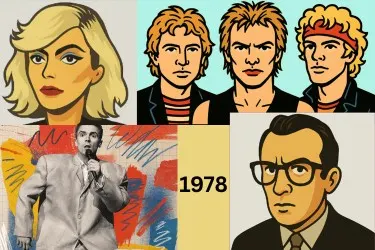
Hello and welcome to New Wave Beat. This is your host, Jason D'Orazio. Take a dive into five great new wave songs from 1978. This is when new wave music was just starting to break through with hit songs and cult classics alike. It was also a sign of great things to come in the style. Let's dive right in!
"Take Me to the River is about trying to reconcile one's lust with Christianity"
Blondie - Heart of Glass
First off is Blondie's Heart Of Glass. It's arguably the first new wave song to top the US chart, so it's appropriate to start here. Blondie released their debut album in 1976, and featured lead singer and frontwoman Debbie Harry. While they had a rough version of Heart Of Glass bouncing around for a while, the final version came out two years later with their third album Parallel Lines.
Heart Of Glass starts off with a fast drum machine hook. It has a strong disco influence reminiscent of Chic and Donna Summer. It also sounds like the music that Blondie influencers Roxy Music had been releasing in the late '70s. Despite the upbeat and fun melody, Heart Of Glass deals with a love gone sour. The narrator is not taking it well as glass hearts shatter easily.
Music videos, while existing in 1978, mostly consisted of the band performing. Heart Of Glass follows this format, but includes some cool shots of Studio 54 and New York skyscrapers. You can see Debbie Harry's aloofness in the video that would quickly become one of her trademarks. While Blondie got a lot of flak from fellow new wavers for selling out with a disco sound, it's unwarranted because the genre is defined by its eclecticism. Also, since new wave and disco acts often shared nights in clubs and bars, cross-pollination seems natural. After its release, Blondie's Heart Of Glass has been heavily sampled and covered, proof of its staying power.

The Cars - Just What I Needed
Next up is Just What I Needed, the first single from the Cars' self-titled debut. The Cars were a five-piece band featuring lead singers Ric Ocasek and Benjamin Orr. Their brand of music was leaning toward classic rock and power pop, but with enough synth goodness and vocal quirkiness to put them firmly in the new wave camp. Initially getting good radio play in the band's hometown of Boston, Just What I Needed soon became a top 40 hit at a time when such songs were only starting to get some good chart exposure.
It starts with a simple but engaging guitar riff. The rock and roll guitars are paired nicely with the futuristic-sounding synth, a combo platter that would permeate throughout the rest of their albums. The memorable chorus and retro yet progressive keyboard outro, in particular, are awesome. Benjamin Orr sings this one and does it flawlessly. It's evocative lyrically as the narrator sings about a crush of his and how he figuratively loses his mind when he's around her. However, the course hints at a little arrogance and possibly codependence on the part of the narrator, saying that he needed, quote, unquote, "a woman to feed and bleed". I personally love this combination of upbeat melody and duplicitous lyrics.
There was no associated video for Just What I Needed, which is understandable since it was slightly before the heyday of music video. As it stands, the Cars would make some nice videos later on in their career. Just What I Needed is great introduction to the Cars and it's Synth and Swagger approved. For something more avant-garde by them, try the song Panorama.
Elvis Costello - Pump it Up
Elvis CostelloLet's talk about Elvis Costello, who debuted in 1977. But I'll focus on Pump It Up from his sophomore album with his band the Attractions. This song is a good blend of punk energy with new wave quirkiness. In fact, Pump It Up is probably the punkiest of the five songs in this article. Starting out with a memorable drum and bass intro, Pump It Up launches into a manic, organ-tinged synth workout which is paired with Costello's almost shouting repetitive vocals. This is a great combo of early '60s rock and punk, showing that new wave music is like a great mixmaster of other styles. I first interpreted the subject being about cranking up or pumping up one's music in response to the various annoyances of life, although there is an alternate theory that the song is about masturbation. For example, lines like, "Putting up your temperature," could be referring to getting tense or sexually tense. Or both. The video mostly features Elvis Costello and the band performing in front of a white backdrop, energetically playing. They're also grooving pretty good to the music. Though it's the only song I'm discussing today that was not a hit in the United States, it's become a classic new wave ditty. It's a great listen, especially for someone who likes edgier new wave. On a side note, Costello has a cool nerd vibe going, which you can see in many future bands such as the Ocasek-produced Weezer.
The Police - Roxanne
Onward now to Roxanne by the Police. The Police were a trio, with tenor Sting the frontman and singer, Andy Summers on guitar, and Stewart Copeland on drums. They debuted in 1978 with the critically acclaimed Outlandos D'Amour which had the US top-40 single Roxanne.
The song begins with Sting laughing in response to a band member sitting on the keyboard by accident. While it's a blooper, it was left in the final cut to give it rawness, honoring the punk ethos the Police were carrying. Roxanne is best known for Sting's pained, extended, and repeated moanings of the title character. This is buttressed by Andy Summers' insistent guitar throughout. The song is about someone who's head over heels for a prostitute. He tries to persuade her to give up her practice and be his only - citing it's the better choice. References are made to a red-light district (designated area for prosititution). Roxanne also serves as a good intro to the band's reggae-inflected new wave.
The Police made two videos for Roxanne, the more popular of which had them performing live. As Sex Pistols' Anarchy in the UK got banned by the BBC, Roxanne certainly continued the tradition of racy songs being banned by the,. Nevertheless, American radio play was a godsend, helping propel the song to hit status. Roxanne made the Police a household name in music circles, with quite a few more hits to come. They also influenced other new wave bands in diferent countries, including Men at Work and Oingo Boingo (believe it or not!)
Available in the Vault
Talking Heads - Take Me to the River
Our 1978 retrospective ends with the Talking Heads' version of Al Green's Take Me To The River. David Byrne fronted Talking Heads, which was known for Byrne's nervous singing paired with R&B and world rhythms courtesy of Tina Weymouth and Chris Frantz. While they had a decent number of hits, but they were also new wave's critical darlings.
Take Me To The River talks about receiving a lover's ill will. The river serves double duty as baptism and the guilt of lovemaking. In other words, trying to reconcile one's lust with Christianity (their video for Once in a Lifetime also refers to religion). The Talking Heads cover is well-played and soulful, yet also deviates enough from the original to make it interesting and worthwhile. It's more free-flowing and has more new wave energy. Thus, it is over a minute longer than the original, but never stalling. And David Byrne's nervous vocals contribute to its fresh vibe. The half-minute intro is simple and catchy, and sets the table for the rest of the song. And don't forget the Talking Heads' version's killer rhythm section. I love Byrne's histrionics around the words "squeeze me" and "tease me" adding some punch. Al Green himself approved of the cover and jokingly hoped to sing a Talking Heads tune one day.
The Talking Heads got a top-40 hit in Take Me To The River, the first in their young career. They made it all the way to American Bandstand, helping put new wave music in the mainstream. No video for this one - but hey, it was 1978.
Bye!
Thanks for listening today to New Wave Beat. Feel free to listen to the five songs I mentioned. If you like them, what about them captures you? This is Jason D'Orazio saying goodbye.
A new one every month.
($8/month USD) Secure checkout with Gumroad

This Week on Synth and Swagger:
Artist Spotlight: Do the Bangles JangleOceania New Wave Song Commentaries (3 free, 6 vault)
Coming Thursday - New Wave Quick Hit