








Intro
As we enter a new year, it’s a natural time to reset and change gears. Sting’s Brand New Day (deftly timed three months before the new millennium) was perfect for this, with its uplifting sound, great metaphors. But solo Sting had long moved on from new wave. Don’t fear, as there’s a batch of excellent new wave odes to new beginnings. These songs treat new starts as decisions, escapes, and recalibrations - not slogans.
“He’s offering himself up as a firewall against society ('stop the world') for her."
Squeeze - The Prisoner
All great resets are preceded by some gloom or strife. Chris Difford describes this vividly in Squeeze's The Prisoner. A suffering housewife’s husband is described in withering terms, such as having “an IQ below 21”. And she herself feels trapped, getting “no icing on her cake”. But the bouncy melody and Tilbrook’s effervescent vocals quickly hint that there’s a happy ending after all. Indeed, by the third verse she finally chooses escape from the prison Difford describes. And in a hilarious twist, her husband is too obtuse to realize what’s happened and is instead fretting on his unattended, burnt dinner. While there are a lot of clever lyrical turns, my favorite is (describing her marriage): “Baked like a cake but without the file. The tool that she needs to make her life worthwhile.” This is an excellent escape song, but let’s now look at songs cross over into new beginnings.

⇩ Song Commentaries Available in the Vault

Eurythmics - Revival
Now that escape was discussed, let’s move to Revival. The synths on this Eurythmics track are more triumphant than usual for them, but it’s perfect for the song. In its two verses, Lennox cheers up a man and woman that she describes vividly as down in the dumps. But in each case she gives a brief but invigorating pep talk. It also mirrors Eurythmics’ own revival: after a 2-year hiatus, they came back firing on all cylinders to make one of their strongest albums critically. Revival in particular introduces guitar crunch and new synth tricks. Lennox, known for her forceful delivery, shows uncharacteristic restraint with Revival. And it works, allowing her other secret weapon, soulful vocals, to shine. I wonder if Lennox is actually giving bandmate Stewart and herself a pick-me-up. In all, an excellent way to kick off the album’s B-side, using external validation as an ignition for a new beginning.
⇩ Song Commentaries Available in the Vault

Falco - Falco Rides Again
Revival is the pep talk, but Falco Rides Again shows the new beginning in full force. Coming after the muted international response to Falco's Emotional, Falco Rides Again plays less like a victory lap and more like a conscious reintroduction - brash, knowing, and very much on his own terms. He refuses the premise of a comeback by comically exaggerating his struggles: he says he’s been “beated, mistreated, gagged and bound”. He even quotes from the morbid Russian poem The Ballad of the Hanged Man. Similar to Eurythmics’ We Too Are One, Wiener Blut is a recalibration for Falco. In particular, he ups the Euro-Dance ante on the A-side. The gang chants of “hey” and “Falco Rides Again”, along with a Spanish-style guitar melody in the bridge, add to the bravado. Like Eurythmics, Falco didn’t retreat. Falco Rides Again showcases one of Falco’s biggest strengths: converting vulnerability into performance by controlling the narrative.

Modern English - Melt With You
Revival and Falco Rides Again deal with new beginnings through recalibration, but Melt With You tackles it after a catastrophe. Unlike Falco, vocalist Robbie Grey is sincere. He reminds his girlfriend of the struggles they have with society (“the world is thrashing around your face”, trying unsuccessfully to change people for the better). He brings up the trinity of societal pressure, emotional claustrophobia, and existential anxiety. But that’s used to highlight their undying love for each other. He’s offering himself up as a firewall against society (“stop the world”) for her. And the title, rather than the cooking of a Burger King cheeseburger, refers to them being so close that they’ll become one entity, in total unison. Modern English delivers the song with post-punk guitars and restrained vocals, but with new wave optimism in the chorus (this dichotomy reminds me of the Psychedelic Furs). Melt With You is about new beginnings, rather than sheltering in place, because Grey lays out the blueprint (human connection) for how to face what’s coming next.
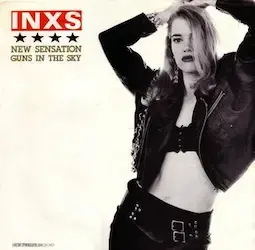
INXS - New Sensation
INXS' New Sensation shares elements with Melt With You: Hutchence is comforting his girlfriend or lover, giving her permission to cry and feel hate in response to life stressors. But then he asks for a shared catharsis in the form of novel sex. Hutchence rarely shied away from a physical answer, but with New Sensation that impulse feels purposeful rather than indulgent. New Sensation has the Jagger swagger that defined INXS from the mid-80s onward. But the guitar riffs and other instrumentation purposely sound more upbeat and optimistic, and gallop at a slightly faster clip. Sure, Hutchence has often belted out a passionate line or two as counterpoints to his cool, slinky vocals. But with New Sensation he sustains the energy, so listeners also get a new sensation. And ultimately their passionate night serves as an elixir, evidenced by the line “and the sun comes, like a god into our room, all perfect light and promises.” It wasn’t an escape, but it energized them to face the morning.
Naked Eyes - New Hearts
After the intensity of New Sensation, New Hearts works as a palette cleanser: less about coping or release, and more about the uncomplicated rush of starting fresh. And with simple lyrics and the song title solely serving as chorus, it also works as an affirmation mantra. That being said, there’s common DNA between New Hearts and most of the other songs in this article: Pete Byrne’s vocal intensity is consistently high, to support the uplifting premise of a new beginning. Byrne explicitly asks his crush for openness and optimism without armor. It’s euphoric, but Byrne avoids naviete and denial by alluding to past struggles just enough. It even serves as a reset within its album Fuel for the Fire, as it comes after the ultimatum-themed opener In the Name of Love.
Outro
New beginnings rarely arrive as declarations. More often, they emerge as small decisions: leaving, reframing, reaching out, or simply choosing a different way forward. New wave understood this instinctively, capturing renewal not as spectacle, but as process. Whether through escape, encouragement, assertion, or release, these songs remind us that starting over doesn’t require erasing the past—only deciding what comes next.
Jason's Commentaries

MORE ARTICLES
New Wave FempowermentBest New Wave Cold War SongsBest New Wave Songs About Work, Jobs & LaborPLAYLISTS
IMAGES