




Intro
The beginning of the ‘90s had a new wave backlash. And while a lot of such artists changed their sound or faded between then and the new wave revival (and response) of the mid-2000s, several artists quietly influenced through producing new artists. There were a few such ‘90s bands I gravitated toward in high school. I didn’t know it at the time, but they were usually new wave-produced. In fact, there were several monster albums and singles that new wavers had a hand in.
Available in the Vault
Trevor Horn (The Architect)
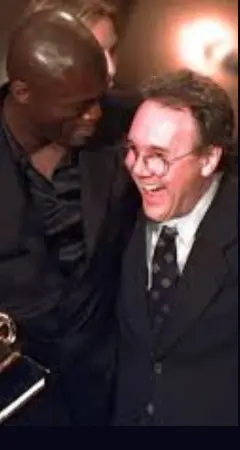
Though the Buggles only had one hit and one album, frontman Trevor Horn quickly established himself as a go-to producer. In the ‘80s he helped launch Frankie Goes to Hollywood and others.
Seal’s Debut Album
I wasn’t a fan of ‘90s R&B, but Seal was an exception. As the ‘90s hit, Horn imported the pop architecture of the Buggles and produced for an up-and-coming Seal. Now most R&B artists went for warmth and a soulful touch. For instance, Boyz II Men turned inward sonically, and opted for gospel chords and warm keyboards, and producers like Jam & Lewis exuded intimate groove and social warmth (they even thawed the Human League's Oakey). Horn, with a new wave background, took a contrarian perspective, framing Seal’s songs with synth architectures. Their large, suspended harmonic spaces give Seal’s a debut a larger-than-life feel, enveloping you in the atmosphere. It’s not a far cry at all from Buggles songs like Johnny and the Monorail, or Frankie's Relax. Seal has excellent, soulful vocals, and they serve as a counterpoint rather than being lost in Horn’s production. He came back several years later to perfect the formula. After establishing Seal’s world, Horn shows a different skill: restraint. Kiss From a Rose succeeds not because Horn disappears, but because he resists his own maximal instincts, letting harmony and melody carry the emotional weight.
 Preview Seal
And Then…
Trevor Horn produced a couple more albums with Seal. He also branched out even more with his production choices, helping artists as varied as LeAnn Rimes, Cher and Tom Jones (yes, his cover of Yaz's Situation).
Ric Ocasek (The Distiller)
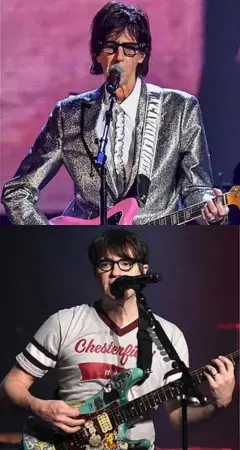
Ocasek’s production history actually overlaps his time with the Cars, lending a hand to cult favorites Suicide and Romeo Void. When the Cars broke up in 1988, Ocasek was still busy - producing a bit and making a couple of solo albums. But his production star rose when he helped launch Weezer.
Weezer’s Blue Album
Weezer was another band I liked; they were an alternative outlier as they opted for tight guitar grooves and detached cool over sludge and angst. Like Elvis Costello, Weezer had a retro-nerd-rock theme going, making Ric Ocasek a great choice for Cars-like guitar action. On Weezer’s debut, Ocasek subtracts distortion-as-identity, stripping the guitars of sludge so melody, not aggression, carries the songs. He also removes emotional overperformance, allowing Rivers Cuomo’s voice to sit in a controlled, almost neutral register where vulnerability feels accidental rather than staged. Ocasek’s influence is clearest in the economy of the guitars. For instance, Buddy Holly’s bridge riff is concise and melodic, eschewing distortion. Also, learning from the best, vocalist Rivers Cuomo develops a detached-yet-human style, highlighted in songs like In the Garage. Even in songs where he belts, like Buddy Holly, Cuomo is restrained like Ocasek.Like the Cars before them, Weezer’s early live presence was intentionally stripped of showmanship: a visual extension of Ocasek’s belief that personality should emerge from songs, not performance.
Preview WeezerAnd Then…
Ocasek applied his success with Weezer to hone the alternative band Nada Surf (which not coincidentally sounds like slowed-down Weezer). Cuomo and the gang invited him back to produce 2001’s Green Album (with Island in the Sun being a hit).
Matthew Wilder (The Savior)
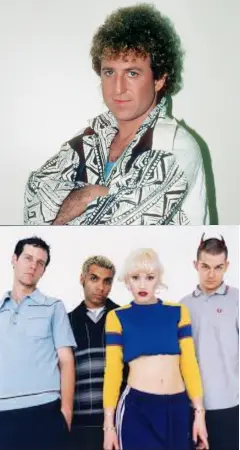
Like Horn’s Buggles, Matthew Wilder only had one hit and one album under his belt. But Break My Stride showed he was capable of tight, hook-laden pop melodies.
No Doubt’s Tragic Kingdom
I liked No Doubt when they got heavy radioplay in the mid-90s. They were an interesting case - debuting in 1992, they were ska revival a few years before it became popular again. They didn’t sell well in part because it went against the grunge grain, but also because their melodies and vocals were loose. Wilder had a pivotal role in tightening them, and playing on Gwen Stefani’s vocal strengths. Wilder also unleashed Tragic Kingdom’s secret weapon: Stefani, reeling from her breakup with Tony Kanal, wrote powerful songs about it. Wilder understood her story and capitalized on this, tightening the melodies around her pain. He also helped Gwen channel all this vocally - for example, her inflections on Don’t Speak are among the best in ‘90s rock. Few bands survive this kind of internal rupture - a situation more reminiscent of Lennox and Stewart's post-breakup reinvention into Eurythmics than a typical mid-’90s alt-rock dynamic. Also, the choruses were crystal clear and the verses tighter, rivalling… Break My Stride! The sound was still definitively No Doubt: their ska leanings were intact (like in the intro to Spiderwebs), but were more disciplined with them thanks to Wilder (who himself had reggae leanings). The result: Tragic Kingdom was a juggernaut, selling over eight million albums in the US alone (much better than the 300,000 for their debut).
Preview No DoubtAnd Then…
Thanks to Tragic Kingdom, Wilder never hurt for production work - No Doubt asked him back for Return of Saturn, and he became a favorite soundtrack guy for a small company called Disney. He even produced for Christina Aguilera and 98 Degrees.
David Ball (The Pivoter)
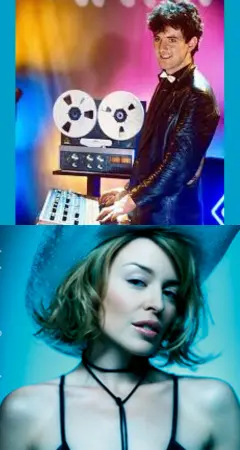
By 1984, Soft Cell had already broken up, but David Ball’s synth stylings were in big demand. He also kicked off a production career, starting with his former bandmate Marc Almond.
Confide In Me and Impossible Princess
Then in the mid-’90s he produced for Australian artist Kylie Minogue. She made a name for herself as part of the Stock-Aikman-Waterman orbit (dating back to her late ‘80s cover of Locomotion). Ball got to produce her 1994 single Confide in Me. It was a perfect opportunity to differentiate and make her sound fresher, using his dark and icy Soft Cell powers to give her a new sound. It has a strong Baroque sound thanks to lyrics like “we all have our cross to bear”, and the slow violin synths. It also allowed Kylie to go in a different vocal direction: trading Bananarama-esque hooks for Siouxsie-esque.
She asked Ball back to produce 1997’s Impossible Princess. Basing a whole album on the Confide in Me pivot was risky commercially, but with the strong single Breathe and others, it worked as she got her luster back in her native Australia and Europe. And while she changed up her sound since, Ball was instrumental in giving her another approach for her arsenal, and in giving her the confidence to branch out sonically in the first place.
Preview Kylie MinogueAnd Then…
Ball only produced a few more albums, but still composed a lot. Also, emboldened by his success with Kylie, reformed Soft Cell in 2002 and made Cruelty Without Beauty. Sonically there are similarities with Impossible Princess.Outro
New wave didn’t disappear in the 1990s: it simply stopped announcing itself. Its instincts lived on through producers who understood scale, restraint, focus, and direction, applying those lessons to artists navigating a very different decade. Horn built worlds, Ocasek cleared space, Wilder contained emotion, and Ball reset trajectories. None of them revived a genre. Instead, they proved something more enduring: that style fades, but craft adapts - and survives.
A new one every month.
($8/month USD) Secure checkout with Gumroad

This Week on Synth and Swagger:
Artist Spotlight: Do the Bangles JangleOceania New Wave Song Commentaries (3 free, 6 vault)
Coming Thursday - New Wave Quick Hit