






Intro
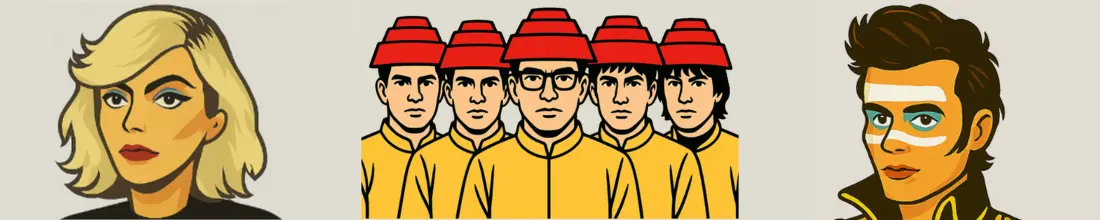
New wave wasn’t just eyeliner and synthesizers - it was also a playground for strange, sometimes brilliant collaborations. From punk icons pairing with electro legends to synthpop stars joining forces with soul royalty, these unexpected duets expanded the genre’s boundaries in weird and wonderful ways. In this premium article, I spotlight six of the most surprising pairings - some iconic, others gloriously obscure. You’ll find guitar gods, movie stars, and disco masterminds crossing paths with New Wave’s most theatrical figures.David Byrne: “Adrian (Belew) could make his guitar sound like an animal, like an elephant or a bird. It added this layer of madness and excitement to the music that we never had before."
Thomas Dolby and Eddie Van Halen
Thomas Dolby's synth gems came at you with fire and ice. So of course he would team up with… Eddie Van Halen?? But hear me out, it actually makes sense. I previously mentioned that Dolby had a great rapport with musicians of various styles (like rap group Whodini). Turns out he helped Mr. Van Halen with some of his sound equipment that was on the fritz. In return he asked if Eddie could lay down guitars for a couple of tracks. If you’re going to fight the grunge tsunami with guitars, go big-name or go home! The results were Close But No Cigar (which I discussed) and Eastern Bloc. The latter was the sequel to Europa and the Pirate Twins. I mentioned Europa had cold war overtones, and that’s strengthened by the title alone of Eastern Bloc (gutsy to release this song seven months after the Soviet Union was no more). Also, the lyrics make references to the Berlin Wall, CNN, and “storming the gate”. Van Halen’s guitar on Cigar prominently features his signature style, and Dolby is great as usual with his emotional vocals with a wink. But Eastern Bloc is actually the better collaboration as Eddie blends better with Dolby’s style. In most of the song the guitars meld nicely with Dolby’s drums and synths, rather than it screaming “watch Eddie shred!”. Even Van Halen’s solo in the bridge somehow sounds like a hard rock guitar version of the classic Dolby hooks we all know and love. Europa and Eastern Bloc are similar in rhythm and hooks. But the synth/guitar dichotomy actually reflects the Cold War/No Cold War paradigm shift.
Play
Close but No Cigar
Thomas Dolby
Talking Heads and Adrian Belew
Talking Heads dipped their toes in polyrhythms with 1979’s Fear of Music. To forge further in that direction, they wished to work with an avant-garde guitarist. Enter Adrian Belew, who had laid down such tracks for and touring with Zappa and influencers-of-new-waveBowie. When the Talking Heads wanted to double down on polyrhythms on their upcoming album Remain in Light, Belew was a natural choice. Byrne himself said it best about his guitars: “Adrian could make his guitar sound like an animal, like an elephant or a bird. It was completely unorthodox, and it added this layer of madness and excitement to the music that we never had before." Adrian played on four tracks for Remain in Light, and toured to support it. His most prominent track has to be The Great Curve. The quick ringing guitar riff throughout the song provides the basis for its polyrhythmic structure. Belews’ speed also serves to tighten Byrne’s vocals, creating a synergy. The title The Great Curve is fitting, as the song is about dealing with life’s curveballs. The lyrics are full of switcheroos like “The world is near, but it’s out of reach”. And what better way to celebrate this than with Belew’s lifelike guitar solos in the bridge and outro punctuating the insistent rhythms. Finally, the 6+ minute runtime gave Belew extra room to work that guitar magic. Not only Byrne was enthralled; Weymouth “poached” him when forming Tom Tom Club the following year (you can hear him well on L'Elephant. After that Belew started his solo career. Give Big Electric Cat on his debut a listen!Play
The Great Curve
Talking Heads
Eurythmics and Aretha Franklin
At first glance, pairing the Queen of Soul with a glossy synthpop duo seems like oil and water. But if the other vocalist is the also-soulful Annie Lennox, that could be a nice pairing! By 1985, Aretha Franklin was enjoying a resurgence with Freeway of Love, while Eurythmics were leaning deeper into soul and gospel influences - fresh off their pastiche hit There Must Be an Angel. So they came together with Sisters Are Doin’ it For Themselves. Though this song appeared on both artists’ 1985 albums, it feels more like an Aretha track featuring Lennox than a true Eurythmics cut. The instrumentation leans classic soul: the Heartbreakers (yes, Tom Petty’s band) handle organ, guitar, and drums - while Dave Stewart’s signature synths are all but absent. The message is bold, but lines like “a woman still loves a man” feel like a hedge - reassuring men more than challenging power dynamics. It’s closer to Aretha’s tradition of soulful assertion than Lennox’s more emotionally confrontational brand of feminism, as heard in tracks like Who's That Girl. Still, the track resonated with women navigating career headwinds and girls looking for role models in the ‘80s, especially with lines like “We got doctors, lawyers, politicians too.” It performed respectably in both the US and Europe. Eurythmics would go on to deepen their soul exploration with tracks like Missionary Man and Revival, while Aretha returned to #1 alongside former new waver George Michael with I Knew You Were Waiting (For Me).Play
Sisters Are Doin' It for Themselves
Eurythmics
⇩ Song Commentaries Available in the Vault

Phillip Oakey and Giorgio Moroder
One of the Human League's tour staples, Together in Electric Dreams, was actually not a Human League song. When Jam and Lewis made the Rock Hall of fame in 2022, they mentioned his turning Janet Jackson into a breakout star. I told my wife they should also get a gold star for making Phillip Oakey sound… well… human in Human. But I forgot about his solo work a year before with Giorgio Moroder (Mr. Heart on his Sleeve). What’s not to say about Moroder? He created the Hi-NRG style with a single track (Donna Summer’s I Feel Love). And he’s behind the Blondie smash Call Me and arguably revitalized Sparks’ career with The No. 1 Song in Heaven. The Human League’s recent album at the time, Hysteria, had more emotion and gravitas than works prior. But Oakey’s vocals didn’t fully catch up to this shift. But when Oakey and Moroder made their eponymous album, that all changed. Moroder, as usual, contributes his highly-danceable, cinematic synths. And I imagine listening to the synth tracks while recording gave Oakey an emotional push that helped give his vocals heart. Indeed, Oakey sings with increased dynamics and passion, capstoned by Together In Electric Dreams. It was good for a British and Australian hit, as well as a US da0nce staple. At least when I saw him perform this as the set closer at a Chicago streetfest in 2012, he genuinely looked pumped. With the albums Crash and beyond, Oakey and the Human League had an extra weapon in their arsenal. As for disco legend Moroder, let’s just say he didn’t have trouble finding more work…Play
Together In Electric Dreams
Phillip Oakey
⇩ Song Commentaries Available in the Vault

Falco and Brigette Nielsen
It’s true: Austria’s biggest pop star and Denmark’s most cinematic Amazon teamed up for a weird, horny Euro single in Body Next to Body. Falco was certainly busy in 1986, having released 2 albums (and a worldwide smash in Rock Me Amadeus). Actress Brigitte Nielsen started her acting career in 1985, with Rocky 4 and Red Sonja opposite Stallone and Schwarzenegger. In 1987 she tried her hand at music, with the Kim Wilde-soundalike Every Body Tells a Story, which did well in Germany. Later that year came Body Next to Body with Falco (who was still a megastar in Austria and Germany). The track was written and produced by Giorgio Moroder (ah, he found more work!), which is surprising given the track is more guitar-forward than either his, Falco’s, or Nielsen’s recent output. Falco raps in the verses; unfortunately his usual energy is lacking and even to a non-German speaker like me its obvious he recycled some of his lyrics from the recent Sound of Musik). Nielsen responds in English - not the most inspired lyrics but delivered with good energy. Falco takes the lead with a more vocally-inspired English chorus, with Nielsen’s help. I don’t have much else to say about the lyrics except that they straightforward about sex. The lyric “turn the pain to pleasure” adds to the… intensity. Falco later claimed - half-jokingly, perhaps - that he only agreed to record Body Next to Body to sleep with Nielsen. Whether or not that was true, the collaboration made perfect sense for two oversized personalities from the continental European scene.Play
Body Next to Body (Rock Version)
Falco

Honorable Mentions
Stevie Wonder was a go-to for new wave artists who wanted a splash of harmonica in their songs. In the aforementioned There Must Be An Angel, Wonder had a great harmonica solo in the bridge. And he helped out Dolby on his contribution to the Howard the Duck soundtrack(!) with Don’t Turn Away. Wonder even laid down a harmonica track for underground band Prefab Sprout’s Nightingales. Though John Lydon (the artist formerly known as Johnny Rotten) was more punk/post-punk, I have to mention his collaboration with old-school electro-rapper Afrika Bambaataa under the moniker Time Zone. The single, World Destruction, is a great fusion of their style at a time where rap/rock crossovers were rare (The Aerosmith/Run DMC version of Walk This Way came a year later). Cyndi Lauper sang (uncredited) the unhinged theme song for the hit show Pee Wee’s Playhouse. Pee Wee Herman returned the favor by being the 911 operator at the end of her appropriately titled song 911. But on that note, let’s end it here.Play
World Destruction
John Lydon
Outro
These collaborations might not always have topped the charts, but they show how elastic and adventurous new wave could be. The genre thrived on aesthetic clashes and sonic experimentation - so it's no surprise some of its most memorable moments came from reaching outside its comfort zone. Hope you enjoyed this look at new wave’s weirdest partnerships.Jason's Commentaries

A new one every month.
($8/month USD) Secure checkout with Gumroad

Coming This Week on Synth and Swagger:
Tuesday - Artist Spotlight: Do the Bangles JangleWednesday - Vault - Oceania New Wave Song Commentaries
Thursday - New Wave Quick Hit
MORE ARTICLES
New Wave FempowermentModern Songs That Sound Like New Wave ClassicsBest New Wave Songs That Are Covers 2PLAYLISTS
More Images