







Intro
Falco was interesting right from his debut in 1982, bringing his European style of new wave but also folding in rap from the inner city US. He was also classically trained, which he also infused into his music. He charted in many countries with the German-language Der Komissar, but US/UK fame eluded him. With his third album he recruited the Bolland brothers as collaborators, and switched from all-German lyrics, to using some English too. The Bollands took Falco’s existing classical stylings and made them theatrical, while sharpening the hooks and dance rhythms around his already outsized persona. This all had the bones of a breakout, and then with Falco 3’s lead single Rock Me Amadeus he topped US and UK charts (and many others). But he wasn’t a one-trick pony. Falco 3 also reached upper-chartdom. Do the non-Amadeus tracks continue Falco’s momentum? Spoiler alert: yes.Rock Me Amadeus
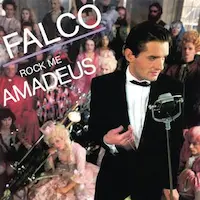
I covered the glory or Rock Me Amadeus through Falco’s artist spotlight, best-of-1986 song, and video commentary, so I’ll focus more on its rise. Rock Me Amadeus was clearly the gateway drug for Falco 3, and Falco himself, to hit it big. But why? Well, the US and UK appetite for continental new wave was increasing, as Nena and A-Ha were showing. After the Fire quickly scoring a hit with their cover of Der Kommisar didn’t hurt either. And the Oscar-winning movie Amadeus took the US by storm just a year prior. But even all this was improbable to pull off without Falco himself. He viewed Mozart as a rock star in stature, skill and swagger, and he wanted to channel that. Bravado. Swagger. A sense of satire just subtle enough to not teeter into Weird Al-territory. He put all this in Rock Me Amadeus’ video and pulled it off. Add a one-word chorus that requires no knowledge of German (or really English)., and the rest is history.America
America is a great follow-up track as it actually deals with the aftermath of Amadeus. Falco likes aspects of American culture and is glad he won it over musically - but that doesn’t mean he’ll pull his punches. He’s skeptical of their sincerity, and skewers its commercialism (selling combs to bald men). With Reagan as cultural aspect of the 80s, Falco suggests this will all survive his terms as President. The music even seems to underline Falco’s outsider perspective. Its accordion and oom-pah-like pulse evoke Central European beer-hall culture. Indeed, Falco and the Bollands eagerly hand America the Central European stereotype it expects - then smirk while doing it. In a nod to internationality, the chorus’s hook is “la-la-la-la-la” (15 years before Can’t Get You Out of My Head). And the Bollands give the bridge has a classical riff.Tango the Night
I wrote about ‘Tango the Night’ as a new wave song with an evil twin, but in the context of Falco 3 it kills as a palette-cleanser from America. Falco does tango with his lover (at night), with passion exuded. But the thrust of the song is that it blends seamlessly with ducking into a private booth for sex. This is a prime example of Falco amplifying his bravado for Falco 3. The Bollands do incorporate tango elements, but laid on the rigidity of a German march, making for an interesting mix.Munich Girls
Falco continues the decadence with Munich Girls. At first this is confusing: how is a uncannily sonically faithful cover of the Cars’ yearning song Looking For Love decadent? Well it’s when Falco’s unleashed and completely changes the theme and lyrics. Falco’s not looking for a girlfriend, he’s narrating his night with a prostitute. With a wink to both the title and us, Falco tells the woman that Munich Girls (prostitutes) do a better job. Read more about it in my soundalikes article. Musically, Falco barely disguises the Cars source; the transformation is almost entirely in attitude, setting and lyrical perspective, which makes “Munich Girls” a neat example of how little Falco needed to change a song before making it sound like his world.Jeanny
Falco closes out side A of Falco 3 with the infamous Jeanny. It’s a departure for Falco in that he almost whispers, rather than raps, the verses. And it reflects the serious subject matter: Falco’s character is frightening and obsessing over a Jeanny, possibly kidnapping her. He’s recalling a recent, unsettling encounter with her down including parts of the conversation. No violence is expressed - Falco focuses on his character’s menace and obsession. For those who don’t know German this is made obvious in the chorus - in zero to sixty Falco goes from his quietest passage ever to his loudest. He shouts for Jeanny, countered with singing female vocals. The video for Jeanny reduces some of the ambiguity - Falco’s characters gets institutionalized, Jeanny leaves a bar calm and unharmed. Based on this, a lot of time has passed, or it’s possible he fantasized the shole thing. It’s unsettling enough to make you flip the record in a hurry - fortunately Vienna waits for you…Vienna Calling
-Now we go out of the dark of Jeanny into the light of Vienna Calling. Sure, it stands in the shadow of the titanic Rock Me Amadeus, but Vienna Calling was no slouch in the charts. And it absolutely holds up. Falco taps on another Vienese classical artist in Strauss, with a riff of the Blue Danube that segues into touchtone phone tones. The title suggests Falco might be abroad and calling back to Vienna. The insistent rhythm make it ridiculously propulsive, and chants add to the fun. Falco’s clipped rapping is in full form here, especially on lines like “Toronto Canada”. It’s fun, but Vienna Calling is actually about Falco lamenting that the Vienese women have all left town for the summer, leaving him bored (so actually a bit of theme overlap with Bananarama’s Cruel Summer). It could get old real quick but Falco has inventive ways to go back to the concept (“Eva becomes Yvonne”, “Stella’s in Tokyo”).Manner des Westens
In America, Falco both welcomes and satirizes the US through the lens of his personal experiences with his music career. Manner covers similar ground, but with America out of his system, Falco has more fun with Manner des Westens. Think upbeat sax-like synths that make you dance, and Falco singing with more bravado. Falco brings up aspects he finds negative like Oppenheimer, and his McRonald line is hilarious. But he also lists what he likes about it (Sinatra, classic coke, etc) . Falco’s rapid-firing these things to you is meant to convey they coexist closely. For example, “you got holy land, you got tomorrow land, you madhouse land”. And if ‘America’ is personal, ‘Männer des Westens’ is Falco zooming out and asking, in effect: how can all of this possibly be one place?Nothin' Sweeter Than Arabia
Notably, the Bollands are absent, making Arabia the bridge track between Falco 3 and its predecessor, Junge Roemer. Furthermore, Arabia’s Middle Eastern stylings recall Roemer’s Tut-Ench-Amon. Arabia shows the evolution with Falco upping the drama on his vocals, and (in a nod to his classical training) using orchestral hits to form a melody during interludes. The lyrics have high-level points about Arabia but also suggest A seductive Arabian-night fantasy deteriorates into fighting, isolation and being stranded in the desert. A backup vocalist keeps declaring “Arabian Nights”, possibly to frame the story.Macho Macho
The Bollands wrote Macho Macho’s lyrics - so they’re a straightforward counterpoint to Falco’s subversion and entendres. In it, Falco is angry at a “macho” guy who took his lady out on a date. But Falco’s character is not a righteous defender of her. In fact, it mocks the concept of machismo by having Falco, who we relate to, acting over-the-top. This means death threats - he says he’s not violent but that’s strictly ironic. And he doesn’t win points for calling his lady “his favorite toy”. The melody is quite catchy is one of the more danceable tracks on Falco 3. Arguably, it strays the most from Falco’s first two albums, though I find it a guilty pleasure.It's All Over Now, Baby Blue
- In an appropriate song title choice for an album closer, Falco cover’s Bob Dylan’s oft-covered classic It’s All Over Now, Baby Blue. While the original was serious, Falco sends us off happy with a tongue-in-cheek lounge lizard style of it. Falco sings like he’s performing live - in the intro he shouts at the horn section to pick up their volume. In the lounge style, there are a couple of short passages that Falco speaks quickly. Clinking glasses and low-volume chatter strengthens the idea that Falco is performing Baby Blue rather than covering it. Given the tone of Falco 3, that’s a smart move.Outro
The Bollands didn’t reinvent Falco on Falco 3 - they amplified him. The hooks got bigger, the rhythms more danceable, and the theatricality more pronounced, but the satire, decadence, cultural collisions and outsized persona were already his. That may be the album’s real trick: Falco became more accessible without becoming less strange. Falco 3 turned his eccentricities into selling points, and for one remarkable stretch, the rest of the world happily came along.A new one every month.
($8/month USD) Secure checkout with Gumroad

Coming This Week on Synth and Swagger:
Tuesday: Album Deepdive: Falco 3Thursday: Pop-Up Video Commentary: Howard Jones' Things Can Only Get Better