




Intro
Hello, this is Jason D'Orazio from New Wave Beat, welcoming you to another episode. Today, we're going to talk about some great new wave songs from the year 1986. New wave was commercially losing a bit of steam by 1986. I'd argue that the last new new wave bands debuted the year prior (like A-Ha). Nevertheless, established new wave acts were still putting out memorable tracks. In fact, 1986 would yield some new wave bands and artist their greatest hits. biggest hits.Rock Me Amadeus
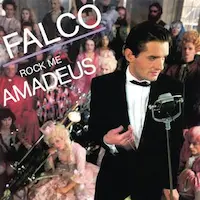
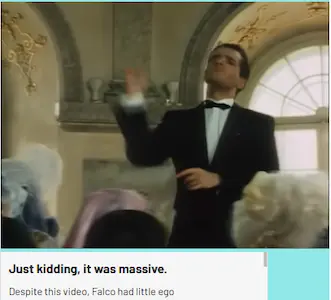
An example of peaking in 1986 is Austrian new waver Falco, thanks to Rock Me Amadeus. Falco debuted in 1982 and scored a couple of Austrian chart-topping albums. Der Kommissar was a minor hit in the US, but a cover version soon after by After The Fire did much better. Falco's breakthrough outside Austria/Germany came with Rock Me Amadeus. In fact, besides his native Austria, the song also hit number one in the US and UK. After a flute-based synth intro, a callback to Falco being a classically-trained musician, Amadeus' verses, as usual, have Falco rapping in German over a synth-based melody. Though I'm not a rap expert, I's say Falco delivers his lines better than other new wavers rapping (sorry Debbie! But it's also a distinct sound from that of '80s rap artists. The chorus is wholly a gang chant of Amadeus, Amadeus, which actually added to its international appeal. Rock Me Amadeus' lyrics talk about how Mozart was in ways an 18th-century version of a rock star or punk, defying that era's norms. The song goes into Mozart's partying and womanizing lifestyle, which actually also described Falco, so there's also an autobiographical element to it. The monetary debts that Mozart incurred in life are also brought up (unfortunately starving artists are nothing new). The US version has an English voiceover summarizing Mozart's life. The video is iconic and inventive. Mozart is traversing through 1986 Vienna with a multicolored wig while Falco is giving a 1786 crowd an Ed Sullivan moment. As Falco is painting Mozart as a 1700s rock star, he becomes an Austrian motorcycle gang's ride-or-die. Falco, knowing classical music, gives out sheet music, rather than demo cassettes, to promote his music. In the end, the two crowds triumphantly mix. Unfortunately, Falco is considered a novelty by many in the US and UK, and didn't have any more hits aside from Vienna Calling that same year. Tragically, Falco died in a car crash in 1998.
▶
Preview Rock Me Amadeus
Falco
Bananarama - Venus
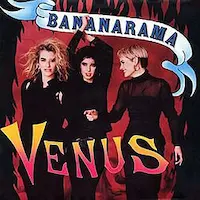
Next up is Bananarama's cover of Venus. Bananarama started out in 1981, influenced by ska and having a tomboyish image. The band consisted of vocalists Karen Woodward, Sarah Dallin, and Siobhan Fahey, along with a backing band. They had a hit with Cruel Summer. 1986 was pivotal for Bananarama, having teamed up with the production juggernaut team of Stock Aitken Waterman. Their image became more glamorized, and soon smashed the charts at number one with Venus. Originally an early '70s song by the band Shocking Blue, Venus was given a hi-NRG makeover by Bananarama, in the vein of Dead or Alive. A driving guitar riff launches into the song proper. The rising baseline in the verses contributes to Venus' danceability. The vocals are a little more restrained, at least compared to the intense instrumentation. Nevertheless, there are some good vocal hooks in there, the biggest being toward the end of the chorus. While the lyrics are not the most profound, they drive home effectively that this Venus is the be-all-end-all. She's described as burning like a silver flame, and the summit of beauty and love. There's one theory that the song was originally about a drag queen. In the video, the trio are singing and dancing on a fire-laden mountaintop with a blood-red sky. This is interspersed with shots of the band members as various femme fatales and Greek goddesses. The vivid imagery and quick edits fit well with the song's hi-NRG melody and tempo, making it an entertaining watch. After having another hit in I Heard A Rumor, Bananarama's commercial fortunes quickly declined. Fahey left the band, but they soldiered on without her. However, the original trio recently reunited and are currently touring (as of 2017).▶
Preview Venus
Bananarama
OMD - If You Leave
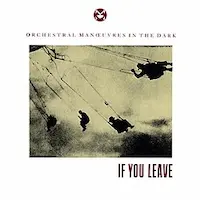
Now we'll discuss If You Leave by Orchestral Manoeuvres in the Dark (OMD). OMD started out back in 1980 with core members Andy McCluskey and Paul Humphreys. They had fared well in the UK, but US success was elusive until 1986 with If You Leave. It managed a #4 there thanks to it being featured in the John Hughes classic movie Pretty in Pink. Interestingly, the song flopped in the UK, where they usually did the best. McCluskey sings gently and smoothly for a lot of the song, but provides emotion and intensity on the right bits. The rhythm section and sax portion in the bridge is quite dynamic, piqueing my interest. The song is about a guy who's lamenting that a long-term crush he has is about to enter a relationship with another guy, in line with Pretty in Pink. Lines like "Seven years went under the bridge," strongly show his pining for her. The narrator says he will run the other way if she opts for the other guy, but the later line, "I won't let go at any price." suggests otherwise. Most of the video has OMD performing with a largely black backdrop with appropos accents of pink. McCluskey is dressed in black as well. Being a soundtrack song, there are obligatory overlays of stills from Pretty in Pink. OMD later had a few more hits in the UK, but couldn't catch lightning twice in the United States. After some personnel changes, OMD disbanded in 1996, but reformed about a decade later. They still put out music and tour (as of 2017).▶
Preview If You Leave
OMD
Wang Chung - Everybody Have Fun Tonight
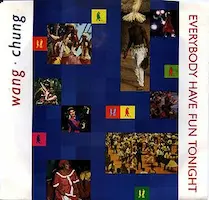
Fourth on our list is British (not Chinese) band Wang Chung's Everybody Have Fun Tonight. Wang Chung debuted in 1982, and had a hit with Dance Hall Days in 1984, but one-upped that two years later with Everybody Have Fun Tonight. Like OMD's If You Leave, Fun Tonight floundered in their native UK. Being 1986, the song has a definite funk element to it, similar to Duran Duran's Notorious album the same year. Jack Hughes' vocals have a funk inflection to them, and are full of enthusiastic vigor. The melody is not the most inventive, but it truly makes many want to dance and have nocturnal fun, so mission accomplished. The drums and guitars are tight and keep the song moving. The horn section delivers arguably the biggest instrumental hook. The bridge is a solid counterpoint to the rest of the song, as Hughes' jumps up in pitch and switches to a ballad format. Lyrics-wise, it's a clarion call for everyone to go out and party, so long as it's to Wang Chung music. The lyrics are simple but catchy. For instance, "I'll drive a million miles to be with you tonight". Though the bridge's lyrics are a bit trippy, referencing the edge of oblivion and a ship of fools. Could the song be sarcastic? Paging Dr. Freud. The video for Everybody Have Fun Tonight consists of the band singing and performing in a wood-paneled room. There is a stuttering visual effect going on with the video, which is kind of cool at first, but after four minutes gets old quick. In fact, in 2017 the top YouTube comment on their video is, "Everybody have seizures tonight". After this massive hit, Wang Chung had a small one with Let's Go, but otherwise disappeared from the music charts.▶
Preview Everybody Have Fun Tonight
Wang Chung
New Order - Bizarre Love Triangle
Last but not least is New Order's Bizarre Love Triangle. New Order formed with members of Joy Division in the wake of singer Ian Curtis' suicide. Bernard Sumner assumed vocal duties, and New Order's sound gradually became more synth-oriented and danceable than Joy Division. Bizarre Love Triangle starts with a harsh synth, but then segues into quite the danceable track. Keyboardist Gillian Gilbert employs several synth styles, but they play nicely together. Stephen Morris's precise drums keep the beat going and add intensity to the song. Sumner's vocals are usually emotive, but he cranks it up a notch with Bizarre Love Triangle. Most of all his inner conflict, which gets me to the lyrics. Sumner sells well he's trapped in a love triangle. I believe he's currently with one of them, while the other is his ex that he is trying (failing) to get over. The singer states, "Well, every day my confusion grows," and "Why can't we be ourselves like we were yesterday?" The pained lyrics contrast nicely with the upbeat and danceable melody. The video is a stream of consciousness, with very fast editing and seemingly random images. An important exception is a person falling, synced with the lyrics "Every time I see you falling". A narrative-based video would have been nice, but it's still an excellent latter-day new wave song. While not a commercial darling at the time, Bizarre Love Triangle has grown in stature in the 30-plus years since it has been released. As for New Order, they didn't have any large hits afterwards, but nevertheless cemented themselves as an essential new wave band to listen to. They made new music as recently as 2015, along with touring.▶
Preview Bizarre Love Triangle
New Order
Available in the Vault
Outro
And that wraps up our retrospective of the year 1986 in the new wave world. This is Jason D'Orazio wishing you a great week from New Wave Beat, and we'll talk to you in seven! Like this article? The Vault has bonus writeups on five articles.A new one every month.
($8/month USD) Secure checkout with Gumroad