



Intro
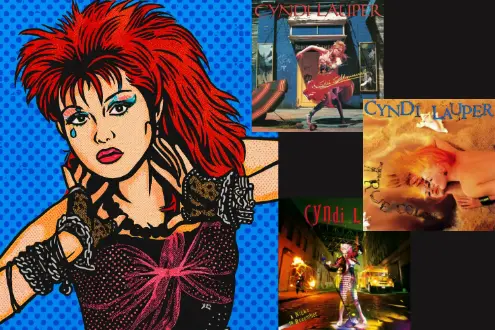
As mentioned before, Cyndi Lauper carried the torch strongly from Debbie Harry, whose band Blondie had disbanded the year before. She is Italian-American like me and grew up in Queens like I did. Though she has a much thicker Queens accent - get her and Wall of Voodoo frontman Stan Ridgway in a room together! Her megahit Girls Just Want to Have Funwas the very first song I remember hearing as a 4-year-old. It may be hard to believe to those my age or younger, but she went toe-to-toe with Madonna in popularity in the mid-80s. While Lauper made great songs after the ‘80s, let’s focus on her three ‘80s albums to give them justice.
"The iconic baseline appropriately sounds like the ticking of a watch, and the other instrumentation is warm, like sitting near a hearth."
She’s So Unusual
She had a band before (Blue Angel), where she honed her neon-punk busker persona. Once Lauper went solo in 1983, she perfected this thrift-store pop-art heroine look, complete with corsets, crinolines and Technicolor hair. She also took voice lessons to sing emphatically while preserving her voice. She’s so Unusual was a multi-platinum juggernaut, spawning 4 (!) top-5 singles in the States. It even edged out Madonna’s debut in sales.
Time After Time
Time After Time is a mature, polished piece that establishes Lauper’s range right out of the gate. Indeed, it’s a great counterpoint to the jubilant spunk of Girls Just Want To Have Fun while keeping it obvious it’s Lauper delivering the track. The iconic baseline appropriately sounds like the ticking of a watch, and the other instrumentation is warm, like sitting near a hearth. The song lyrically tugs at the heartstrings. Besides the time metaphors (“the second hand unwinds”), Lauper assures her lover she’ll always be there for him with sincerity and empathy in her voice (rather than the shouting of Girls Just Want To Have Fun). Finally, Lauper using the song title as a mantra in the outro seals the deal.

Money Changes Everything
After the DIY sparkle and anthems of her singles, Lauper goes a tougher route with Money Changes Everything. Indeed, it’s the black sheep of the eccentric She’s So Unusual, as it’s the lone social commentary piece. Note that Lauper sings in the third person, keeping the focus on the social rather than the personal. Also, it has a heartland rock sound with the instrumentation and straightforward-but-resonate lyrics (think Springsteen). But Lauper still gives Money Changes Everything her unique flavor. For example, in her trademark transition from singing to shouting in the outro, vocal hiccups, and her Queens accent.
She Bop
Sure, Madonna was a lot more explicit about sexuality, but where she scandalized, Lauper snickered - wielding humor as her weapon with the masturbation - themed She Bop. The multitude of references to this activity cite pop-culture references and proverbs (e.g. “I’m picking up good vibrations”). She even tosses off lines about "the Danger Zone" and 'New Sensation' - years before either song existed, as if she’d borrowed Doc Brown’s DeLorean for a quick spin through MTV’s future. Lauper has tonal range in spades: she was sincere with Time After Time but quite the opposite with She Bop. She’s irreverent to the point of heavy breathing and snickering. From front-to-back, the music chugs along at a brisk pace to keep you hooked. The animation in the supporting video is funny, complete with a self-service gas pump. Kudos to Team Lauper for squeaking the song and video by the radio and MTV censors!
True Colors
As opposed to albums like Duran Duran's Rio, True Colors was a sophomore slump for Lauper. My friend theorized that Lauper dropped off in popularity, while Madonna surged, because of her appearances in WWE (wrestling). For instance, Lou Albano was her dad in the Girls Just Wanna Have Fun video (alongside her real-life mom). Also, she railed against Roddy Roddy Piper and the Iron Sheik in Goonies ‘R’ Good Enough (I first discovered this song in the Goonies Nintendo game!). Now in the backdrop of new wave bands feeling pressure to drop their eccentricities in the changing music landscape, all this may have eventually served to hamper her music sales. This is also where Madonna surges ahead of Lauper, beating her 7-to-2 million in album sales.
True Colors
The title track to True Colors is a calming song with an excellent message of inclusivity. This is thanks to the instrumentation and almost-lullaby-toned vocals. The sparse, gentle African drums work nicely for this song. Vocally, True Colors reminds me of Time After Time, but Lauper’s more varied in Colors. For example, Lauper lets loose a wail just once (toward song’s end), which makes it that much more emphatic. As a lead single it may have unfairly indicated that Lauper lost her sonic spunk.
Change of Heart
Change of Heart initially fell under my radar despite it almost topping the American charts (maybe because it was in the shadow of True Colors). It’s a good amount more uptempo and dissonant - a good counter-choice as the “other” single off True Colors. With its rubbery synth line, the dance inclinations, and clipped, intense drum hits, Change of Heart reminds me of Paula Abdul (who debuted a bit later), but obviously edgier and spunkier. In Change, Lauper is trying to pull her friend, in her over-the-top vocal style, out of the friend zone. There’s quite a few examples, but the highlight is her chanting of “turn it around” (the friendship into romance). A cool bonus is that she gets a vocal assist from fellow new wavers the Bangles.
A Night to Remember
Lauper waited three years before A Night to Remember, which only sold about a half million copies in the US, compared to 5 million for Madonna’s Like a Prayer that same year. By decade’s end, Lauper’s originality felt stranded between new wave’s fadeout and adult contemporary radio’s polish.
I Drove All Night
Lauper had her last top-40 US hit with the Roy Orbison-penned I Drove All Night. This lead single was released four months after Orbison’s unfortunate passing. While it gained traction by inadvertently being a tribute to Orbison, Lauper channels his lyrics movingly and it deserved to be a hit anyway. Lauper’s vocals are deeper and more sultry than in her other hits, which is a refreshing change of pace. This is heard in the verses and most of her wails. Her weary-yet-horny vocal delivery also fits the lyrics well - after all, she spontaneously drove half a day for this romantic rendezvous.
Available in the Vault
Outro
Lauper’s ’80s trilogy captures something rare: a pop star who stayed defiantly human while the decade airbrushed itself into perfection. She laughed, wailed, and occasionally wrestled her way through trends, but never lost her Queens grit or her Technicolor heart. Replaying these songs today, you still hear the mix of empathy and mischief that made her singular. Even when she wasn’t topping charts, she never stopped sounding like herself—and that’s her truest color.
Like this article? The Vault has bonus writeups on five articles.
A new one every month.
($8/month USD) Secure checkout with Gumroad