



Intro
Hello, and welcome to New Wave Beat! I'm your host, Jason D'Orazio. Let's take a dive into five seminal songs from 1980. 1980 was a banner year for new wave music, as songs began to crack the year-end top 100 Billboard charts.
"The Pretenders were close to the spirit and aggression of punk, though mixed in with Rolling Stones and Who influences."
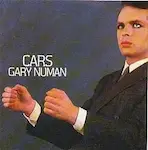
Gary Numan - Cars
Numan's music was the a brand of new wave called synthpop. And yes, there's heavy synthesizer use, along with a love for Kraftwerk. Numan's classic, The Pleasure Principle, had Cars, which hit the top-10 in the US. The buzzing intro sounds like insects, and then a well-known five-note riff repeats throughout. The cold synths set the tone for the song, followed by Gary Numan's detached vocals - textbook early synth pop. Despite not having a chorus Cars managed to catch on thanks to the diverse music landscape of 1980. Only about a minute of the song contains vocals, so you may be bored singing this one at karaoke. However, the terse lyrics speak volumes. They describe being cocooned in a car, a metaphor for human isolation. More on that aspect of Cars here. At first, the narrator likes the safety of his car, but by song's end, he gets lonely and wants out.
The music video for Cars has a futuristic motif, with a black backdrop and Numan in a red suit. When a tambourine plays, Numan's face is shown inside of it. Towards the end, multiple Gary Numans are steering (you guessed it) cars. What's great about the song is that Numan takes the instruments, vocals, lyrics, and video and forms a consistent narrative about the perceived coldness and isolation that comes with technology. Cars was Numan's biggest hit, but he continues to record albums into 2017, with dystopian themes still ruling the roose. In the '90s and beyond, he gradually turned to more industrial sonics.

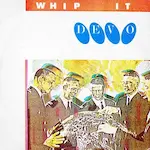
Devo - Whip It
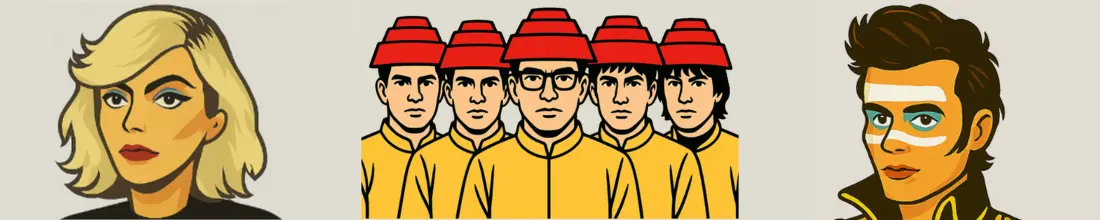
On deck is Devo's biggest hit Whip It. Devo debuted in 1978 from Akron, Ohio with a quirky, robotic form of new wave. While they are quite distinct, they're sonically closest to the B-52s and XTC. While they had a cult following early on, Whip It (off their third album) gave them a wider audience.
Whip It appropriately moves at a whip-like pace, clocking in at under three minutes. But like a lot of other new wave songs, less is more. The drum intro identifies the song quickly to even the casual. Synthesizers drive a lot of the song, including the memorable whip-like effects and five-note riff that plays during the verses. Members Gerald Casale and Mark Mothersbaugh alternate vocals in a call-response format to great effect. Whip It is a delightful amalgam of the energy and absurdity of punk, with the sheen and sometimes detached nature of synthpop.
Some people think the song is about S&M because of the whip, but I think Whip it is more about blind optimism. Devo highlights the absurdity of reflexively employing the same quick, easy solution (whipping it), in response to whatever life throws at you.
The iconic video features the band performing in their famous red energy dome hats, along with a loose narrative. The video is based in a stylized American Wild West, portrayed with log cabins and cowboy/girl outfits of some of the characters. The band uses a whip to take clothes off a woman, and a cross-eyed woman shoots at a can of beer held by someone, both of which raised some eyebrows. The quirky Whip It managed a top-40 showing in the US, but none of their other singles achieved those heights. Nevertheless, Devo still they have a dedicated fanbase and a lot of other critical darlings to enjoy.
⇩ Song Commentaries Available in the Vault
The Pretenders - Brass in Pocket
Next up is Brass In Pocket by the Pretenders. Though released in 1979, it scorched the charts in 1980. The Pretenders were close to the spirit and aggression of punk, though mixed in with Rolling Stones and Who influences.
Brass in Pocket employs a simple but hummable and memorable melody. An eight-note riff sets the tone for the song, and the tempo is slower than other songs off the album. Little to no synths were used on this one, changing it up from the previous two I mentioned today. Chrissie Hynde's prominent sultry vocals are excellent and are the highlight of the song. She provides emphasis on the right words in order to make things dynamic. Brass in Pocket's lyrics describe a potential sexual encounter with a guy and her confidence in the way it is going to happen ("Gonna use my arms, gonna use my legs."). Indeed, the lyrics are powerful and cut to the chase. I also think name-dropping Detroit is kind of cool (Hynde grew up in nearby Ohio).
⇩ Song Commentaries Available in the Vault

I give kudos to Brass in Pocket's video for its storytelling. In my book a video with a strong narrative is usually better than one with a band just performing. In its video, Hynde works as a waitress at a restaurant that is nearly empty. She took a liking to one of her customers before, and she fixes her hair, perhaps in expecting him to arrive. The customer does walk in, but unfortunately, he is with another woman. The customers later leave and Hynde is left alone and dejected. In retrospect, Hynde didn't like the passive role she played in that video, and the song itself. The Pretenders had several other hits in the '80s and are still releasing new material and touring.
The Vapors - Turning Japanese
The fourth song we're covering is Turning Japanese by the Vapors, a short-lived new wave group similar to XTC and the Knack (of My Sharona fame). After their debut single flopped, Turning Japanese made the US top-40.
The verses of Turning Japanese start off with the "Asian riff". There are a few other faux Asian elements to the song as well. The spiky guitar chords and fast tempo have good energy, certainly influenced from punk. Vocalist Dave Fenton delivers aggressive clipped vocals, matching the song's vibe. The lyrics of the song have been discussed a lot in new wave circles. It's evident that the narrator is pining over a love interest. The turning Japanese part is more open to interpretation. Some say it's a euphemism for masturbation, whereas the more innocent angle is that he wants to relate to his Japanese love interest better. Lyrics like, "I often kiss you when there's no one else around", could be referring to pictures of his love interest or the Japanese stereotype that frowns on public displays of affection.
The video runs with a more innocent interpretation. It features the band performing on a archetypical Japanese-style set, complete with a Japanese woman dressed like a traditional geisha. To round this out, the band brandished samurai swords. Unfortunately, the Vapors released just one more album in obscurity before calling it quits. Actress Kirsten Dunst covered and shot a video for this song a couple of years ago, which easily earned a skip.
The Romantics - What I Like About You
Let's cap off this 1980 list with What I Like About You by Detroit rockers the Romantics, coming off their eponymous debut. Like the Vapors, the Romantics are also similar to the Knack.
The intro is very catchy and memorable. The song has dissonant yet upbeat guitar chords, paired with vigorous drumming by Jimmy Marinos and clapping. Marinos also provides vocals, with raw enthusiasm. Shouts of "Hey!" further increase the energy. The instrumental bridge features a memorable harmonica part that accompanies the guitars and drums. Like several other of the songs I discussed, this one is brisk at just under three minutes. The lyrics are the most straightforward of the bunch discussed here. What I Like About You is Marinos' character talking about someone's partner, and why he has a crush on her. Lyrics like, "Never wanna let you go. Know you make me feel all right" are par for the course with What I Like About You. Repeating the song title shows a bit of punk influence.
The video is also straightforward as all of it is the band performing the song in black outfits in front of an also-black backdrop. Marinos is doing a good job with drumming and singing at the same time, both with vigor. While What I Like About You wasn't a top-40 hit in the US, the song got a good amount of radioplay in subsequent years. Yes, it aged a lot better than The Electric Slide. The Romantics struck again several years later with Talking In Your Sleep, along with more albums. The Australian band 5 Seconds of Summer recently covered What I Like About You. It was tolerable, but no better.
Outro
That wraps up my episode for today. This is Jason D'Orazio at New Wave Beat wishing you well.
Like this article? The Vault has bonus writeups on five articles.
A new one every month.
($8/month USD) Secure checkout with Gumroad