




Hello!
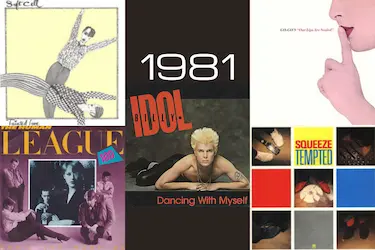
Hello, everyone. Welcome to New Wave Beat. I'm your host, Jason D'Orazio. This episode, we'll take a dive into five new wave classics from the year 1981.
1981 had a lot of new wave hits, and this is where such songs became slicker and synthier. Nevertheless, there was still room for eclectic sounds within the new wave umbrella. Without further ado, let's get to it.
"Dancing With Myself was reportedly inspired by a type of dance club in Japan where partygoers would dance by themselves in front of full-length mirrors."
Tainted Love (Soft Cell)
Let's begin our retrospective with Tainted Love by Soft Cell. Soft Cell debuted in 1980 with a single dubbed Memorabilia, then soon followed it up 1981 with Tainted Love.
Soft Cell is squarely in the synthpop vein of new wave. Tainted Love was originally an obscure mid-60s single for Gloria Jones. Soft Cell updated the sound for the new wave-friendly '80s. That meant a synthpop treatment, but some of the soul elements of the song were kept. For example, the "Oh, oh, oh, oh" backup vocals. Instrumentalist David Ball layers the synths and drum machines to great effect. For instance, a two-note synth riff provides some of the rhythm and instantly identifies the song to the listener. Soulful and wistful vocals by Marc Almond on Tainted Love pay homage to the source material, and his range is pretty good to boot.
The lyrics indicate that the narrator is in the death throes of a toxic relationship. Words like "Once I ran to you, now I'll run from you," and, "I'm gonna pack up my things and go", imply that he had a recent epiphany that it is time to end the romance.
The video has a Roman theme to it, mixed in with croquet outfits and equipment. The video has an emperor looking regal, but it strongly suggests that his wife cheated on him with a Roman slave. So yeah, I doubt this video is well received today. While it was quickly a number one hit in the UK, it took a while longer for it to go top-10 hit in the United States.
Soft Cell recorded a few more albums, but didn't have an American hit nearly as big as Tainted Love. David Ball went on to produce for Kylie Mingoue and others in the '90s. Marc Almond still records and performs solo. Check out a focus on Tainted Love as a cover song.

Don't You Want Me? (Human League)
The second song on our 1981 list is Don't You Want Me? from the Human League. This band, with frontman Phil Oakey, put out their debut album in 1979, which was eerily good and deeply influenced by Kraftwerk. Then came 1980’s Travelogue, with haunting tracks like The Black Hit of Space. They changed up their sound with 1981's Dare, adding singers Joanne Catherall and Suzanne Anne Sully. The band had three successful singles in the UK, but failed to chart in the United States. The League reluctantly agreed to have Don't You Want Me? released, and it became a #1 smash in both countries and more.
“Don't you want me, baby? Don't you want me, oh-oh-oh-oh!”
A fast-paced synth provides a danceable pop rhythm throughout the song, with a keyboard splashing color at appropriate moments. The highlight of Oakey's vocals are the pitch-climbing leadup to the chorus and the chorus itself. The sliding "Oh-oh-oh-oh" at chorus' end effectively sells the pleading nature of Oakey's character. Sully sings the second verse as a response, then two more choruses by Oakey with a short bridge in between. The song is about a power-hungry man who claims that he's the reason for his girlfriend's fame, and he, quote, "Can put her back down too." She rebuts his claim and states that while she still loves him, it is time for her to move on.
The video is more nonlinear and vague with its approach. In it, Catherall is acting in a movie while Oakey and Sully hang out by the set. Meanwhile, the rest of the band is busy in a video editing room. The cinematography and editing are pretty good for the turn of the '80s. After the smashing success of Don't You Want Me?, the Human League had a few more hits in the '80s and '90s, and an occasional new album after that.
Meanwhile, Don't You Want Me? has been covered over the decades, including by Neon Trees in the 2010s, which speaks to the song's enduring nature.
⇩ Song Commentaries
Tempted (Squeeze)
Okay, now let's talk about Tempted. This was created by Squeeze. Squeeze, named after the notorious last album credited to Velvet Underground. They started out in 1978, featuring the deft songwriting skills of Chris Difford and Glenn Tilbrook. They had many hits in the UK, such as Pulling Mussels, but never had one in the US until their fourth album, with the Elvis Costello-produced Tempted.
“Tempted by the fruit of another. Tempted but the truth is discovered. What's been going on?”
The lead singer of Tempted was actually Paul Carrack, an on-and-off band member, with Costello and the honey-tongued Tilbrook singing one of the verses. Tempted is mid-tempo, or perhaps a little bit slower, and clocks in at exactly four minutes. The song has some blue-eyed soul elements to it, thanks to Carrack's vocal style and church-sounding organ. Backup doo-wop vocals add to the soul pastiche.
As indicated by its title, Tempted suggests it's about a guy's temptation to cheat on his girlfriend or wife. Though lyrics like, "Now that you have gone, there is no other," suggest that the temptation might have occurred after the relationship ended. Either way, the narrator is queasy about this, as judged from the quote, "Alarmed by the seduction, I wish that it would stop." Still, the lyrics are open to interpretation. Unfortunately, the video for Tempted is no longer on the interwebs, so I cannot include it on my accompanying playlist.
Tilbrook still considers Tempted to be one of his favorite Squeeze songs. Although Tempted didn't quite make the top-40 charts in the US or any other country, it grew into a new wave classic. Its inclusion in the popular movie Reality Bites gave it a second life in the mid-'90s (I would sometimes hear it on the New York hits station Z100). Even now (2017) Tempted still gets decent radio play. Squeeze regularly made more albums until the late '90s, and recently reunited for a couple of new albums. Give them a listen.
⇩ Song Commentaries Available in the Vault


Our Lips Are Sealed (the Go-Gos version)
Next up on our list is Our Lips Are Sealed by the Go-Gos, which is the lead track off their debut album Beauty and the Beat. This wild all-woman band was part of the diverse Los Angeles new wave scene, starting out with a punk sound, but crossed over to new wave by the time of their first album in 1981. Their influences include new wave legends like Blondie, but also early '60s female artists like Lesley Gore.
“Everybody wave. Hey, hey. In the jealous games people play. Hey, hey, hey.”
Our Lips Are Sealed has a '60s girl group sound modified by new wave pace and grit. Belinda Carlisle (with a Jane Wiedlin assist) provides effervescent vocals to a fun-sounding song. A highlight of Lips is Wiedlin's high-pitched vocals in the bridge. The guitars and keyboards are catchy, and the tambourine adds a little spice to the rhythm.
While Our Lips Are Sealed sounds 100% positive, its lyrics are darker. The song is a clarion call by the band to not respond to vicious rumors and gossip hurled by others. They tell you to pay no mind to what they say, doesn't matter anyway. And there's an air of optimism as they're presenting a solution, allowing stuff to roll off your back to those rumors.
The theme of the Our Lips Are Sealed music video is more positive as it shows the Go-Gos having fun on a sunny day in Los Angeles. The video alternates between the Go-Gos performing, driving around the streets of LA, and visiting shops. Towards the end, they play without worry in a public fountain. Our Lips Are Sealed hit the top 20 in the United States, but didn't fare as well in the United Kingdom. Interestingly enough, the band Fun Boy Three, whose frontman Terry Hall helped write Our Lips Are Sealed, covered the song shortly thereafter, more revealing of the song's backstory, and it became a hit in the UK. The Go-Gos had a few more hits and two more albums in the 80's before going on long hiatus.
⇩ Song Commentaries Available in the Vault
Dancing With Myself (Billy Idol)
To conclude, let's go over Billy Idol's Dancing With Myself. It was originally credited as being by punk/new wave band Generation X, of which Rock Hall nominee Billy Idol was the front man. Idol then took their last single, tweaked the mixing of the vocals and instruments, and then made it the debut single of his solo career in 1981. Like the circle of life (take that, Elton John!).
“Dancing with myself. I'm dancing with myself. Oh, well, there's nothing to lose. And there's nothing to prove. Dancing with myself.”
The song is a good combo of punk energy and new wave danceability thanks to its rocking vocals and guitars, and insistent rhythm section. A six-note repeated guitar riff is the main identifier of the song. Toward the end of the song, Idol chants “Sweat!” with infectious punk speed and intensity. That being said, he's judicious in where he provides vocal emphasis. Good in my book!
The song was reportedly inspired by a specific type of dance club in Japan where partygoers would dance by themselves in front of full-length mirrors. The song does reference Tokyo and those mirrors. And on a deeper level, the song can be seen as a commentary on human isolation despite being physically around people. Lyrics like “The crowded lonely night” hint at this interpretation.
The video for Dancing With Myself has a post-apocalyptic feel. A bunch of people are clamoring to climb a tower with Billy Idol at the top. Using electricity bolts, Idol propels them off the tower. He just wants to dance with himself, fair enough. But eventually, Idol comes around and lets them join the dance party. While not a chart success, Dancing With Myself is considered a classic and is still gets good radioplay in 2017. Idol put out several more records in the '80s and '90s, leading to quite a few more hits. Later on, he tacked on a few more albums.
Outro
And that's a review of five epic songs from the year 1981. This concludes this episode of the New Wave Beat Podcast, with your host Jason D'Orazio. Many thanks, and we'll talk to you next week.
A new one every month.
($8/month USD) Secure checkout with Gumroad

This Week on Synth and Swagger:
Just Released: Beyond New Wave: Pet Shop Boys and Erasure - Immediate FollowersThursday: New Wave Quick Hit
Friday: Playlist of the Week
Explore More Artists
SqueezeThe Go-Gos