


Intro
Bands like the Human League and Ultravox came on the scene in the late ‘70s with a heavily-synth approach inspired by Kraftwerk and Brian Eno. The songs sounded fresh not just because of the novel way these synths were utilized (not as a novelty like Del Shannon or instrumental like Kraftwerk) , but in their music it often sounded icy and bleak. Paired with detached vocals and dystopian lyrics, synthpop had a distinct sound. As with punk spinning off into new wave, post-punk and hardcore, synthpop branched out too, pushing it in exciting new directions.OMD
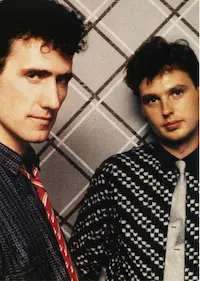
In a departure from the synthpop of 1980, Orchestral Manouveres In the Dark (OMD) wished to imbue a humanist element into their music. Rather than building dystopian worlds, they often boil it down to the personal level, whether it be Joan of Arc or simply someone who’s mourning a lost love.Enola Gay
Enola Gay is a contender for the synthpop song most subversive to the style. First off: a song about the plane that dropped the first atomic bomb is heavy subject matter. OMD could have broached the subject with a clinical detachment associated with early synthpop. But instead vocalist McCluskey puts the plane on trial, like it was a person, challenging it with lyrics like “is mother proud of little boy today”? In line with this, McCluskey’s tone has an angst hinting at post-punk. While Ultravox’s John Foxx made humans machinelike, OMD succeeded in the opposite. And of course, Enola Gay’s melody is one of the most delightfully effervescent melodies in new wave, let alone turn-of-the-80s synthpop. The intro and bassline, a high-pitched, slithering synth, manage to be the main hook in an already-catchy song. Read our blurb on Enola Gay as a Cold War song .Souvenir
OMD had more than the subversion trick up their sleeve. They could use synths to straight-up move you, like in Souvenir (one of the most moving tracks for me personally). Paul Humphreys opts for soft synth timbres that bloom and linger, giving the song a floating feeling. Souvenir’s repeating chords produce a sense of reaching then falling away, much like yearning for a time in the past. And while Souvenir’s light on lyrics, Humphrey subs in for McCluskey and his raw sadness (free of McCluskey’s Enola angst) economically finish the job of grabbing the listener’s heartstrings. Preview OMD
Soft Cell
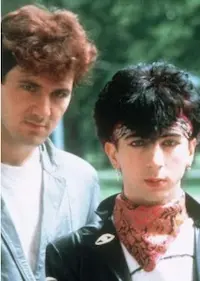
If early synthpop was antiseptic, Soft Cell was for sure septic. Their debut is a loose concept album around urban sleaze. Sure, Marc Almond often sounded detached, but rather than being emotionless he sounded snarky, like he was above the seedy vignettes he laid out. But at the right moments, he came at you with sneers dripping with disgust. David Ball's synths were often richer and more dynamic, and often slid in pitch (quite aggressively on Sex Dwarf).Bedsitter
Bedsitter shines an unforgiving light on Britain’s nightlife scene. And while Almond gives a first-person perspective, there’s definitely a snooty observer quality to it. He easily could be describing any unfortunate Londonite stuck in this cycle. Through snark, he shows the absurdity of a night out in detail, including the automatic decision to do it all again the following weekend. That cycle is the tragedy, not any one night. David Ball used his horn-like synths a certain way to give Bedsitter a claustrophobic, noir air to them. Indeed, they wander restlessly throughout. But it never veers into listlessness, and is crucial in selling the futility of the song. Almond and Ball join forces effectively to make you feel like you are also stuck at a sleazy lounge full of despair.Say Hello, Wave Goodbye
But Soft Cell wasn’t all about observation. While Almond observes the mess of Bedsitter, in Say Hello, Wave Goodbye he is the mess. Say Hello is theatrical in spades - it wouldn’t be out of place in a theater show’s climax. I was immediately struck by the disgust in Almond’s trailing lines. The lyrics are equally venomous, with “we had a kind of so-so love” a standout. He’s really letting his about-to-be-ex-girlfriend have it verbally. But slowly we realize that Almond’s wounded, punctuated by the chorus where, in a pained voice, he finally lets go of their relationship. David Ball deftly pivots from the claustrophobia of Bedsitter and gives his synths room to breathe. During the dramatic chorus he goes full atmospheric with sustained synth notes, buttressing Almond instead of competing.Preview Soft CellABC
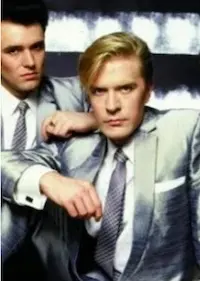
Like Soft Cell, ABC went heavy on emotion. But while the former delivered the sleaze, ABC took the opposite tack. Frontman Martin Fry sometimes had a crooning style reminiscent of Bryan Ferry, and wore smart suits to match. But other times, for more emotion, he drew from soul music with his vocal flourishes. There’s call-and-response vocals abound, like in Look of Love: ”Who’s got the look” “You’ve got the look!”. And while ABC had a lot of emotional pain, it was in the service of catharsis - like when Fry got his actual ex-girlfriend to dump his fictional character too with a cold “goodbye”. ABC surrounded their electronics with horns and real orchestration, including Anne Dudley's lavish string arrangements, giving the songs an air of sophistication.Poison Arrow
In Poison Arrow ABC show several elements of soul. An obvious one is the hornlike synths that permeate. But it goes deeper: Fry, like many soul vocalists, loved the call-and-response style. In the bridge, actress Karen Clayton responds to Fry’s pleas with an almost-snickering rejection (Lisa Vanderpump, incidentally, played his unattainable love interest in the video). And it doesn’t end there - Fry argues with his own internal monologue and even banters with his bandmates. He shouts “the sweetest melody”, and the band replies with an almost comically sweet riff. This recalls James Brown talking with his band on studio recordings - a quirk that Fry admired about him. Where Almond wallowed in heartbreak’s ugliness, Fry wore his heart on his sleeve and turned it into a production number.When Smokey Sings
After Lexicon of Love, ABC took interesting musical turns, mixing in guitars and boosting their sound into the zillions. But with Alphabet City, ABC leans on sophisti-pop soul stylings again. It gets literal with When Smokey Sings, an homage to Robinson himself. And as an homage, Fry dials back excesses and gives his Ferry-style croon instead. The band echoes a bassline from Tears From a Clown but it blends well into the song - it’s like Fry is listening to the Robinson chestnut in real time and admiring it. The female vocalists responders are there, elevating Fry’s monologue to a conversation with “ooo-ooo” and other flourishes.Preview ABCAnd the Branches Kept Growing...
The bands I discussed were three important offshoots of early synthpop, but not the only branches. Here are some others…- Depeche Mode - darkness/industrial textures
- Howard Jones - Zenlike warmth/optimism
- Yazoo - blues/soul vocals
- A Flock of Seagulls - guitar-driven/space-age new wave
Available in the Vault
Outro
Synthpop didn’t stop sounding like synthpop when it loosened its original icy grip. It just discovered how much territory those machines could cover. OMD found humanity in them. Soft Cell dragged them through the city’s underbelly. ABC dressed them up and taught them some soul. And those were hardly the only paths forward. Once synthesizers stopped representing the future and simply became instruments, artists could use them to build worlds as varied as the people behind them.Like this article? The Vault has bonus writeups on five articles.
A new one every month.
($8/month USD) Secure checkout with Gumroad