




Hello!
Let’s go over some key new wave songs from 1979, which scored a lot more hits than prior. This will be a snapshot of a movement quickly gaining momentum.
"In Video Killed the Radio Star, a classical musician has their symphony automated by machinery, thereby stealing their songwriting credit."
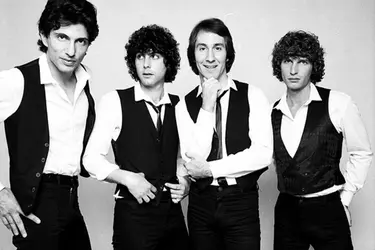
The Knack - My Sharona
The first song we'll cover is My Sharona. It was performed by the Knack, who formed in the late ‘70s. For similar bands, look to the Romantics, Cheap Trick, and Blondie. My Sharona was the lead single off their debut (Get The Knack. It was a juggernaut, staying atop the US chart for six weeks.
The intro's drum hook is quite memorable, along with the guitar riff and flowing bass that permeate the song. The singing is energetic and passionate, with lead Doug Fieger’s stuttering for effect. For example, a couple of “oohs” and the iconic “ma-ma-ma-my Sharona”. The long guitar solo in the bridge also slays and deftly compliments the rest of the song. The melody even has a surf overtones to it, particularly in the guitar.
The lyrics are about being turned on by a younger love interest. There are hints that the singer’s lust is unrequited. For example, a line like “When you gonna give it to me?”. The words are a bit lewd, citing body reactions from the touch of the younger women. Nope, not a lot of double entendre with this one, but the melody picks up the slack for the straightforward lyrics.
No video was made for My Sharona, but that was common in the pre-MTV era, so that's fine. YouTube has live performances of My Sharona. Shortly after its release, Weird Al Yankovic debuted with his parody dubbedMy Bologna. Alas, the Knack could not follow up on the success of My Sharona and had only two more albums before they broke up for about a decade.

Joe Jackson - Is She Really Going Out With Him?
Next up is Joe Jackson’s chestnut, Is She Really Going Out With Him? Joe Jackson, not to be confused with Michael Jackson’s father, was a classically trained musician who quickly latched onto the aggressive energy of the punk and new wave movement. He debuted in 1979 with the album Look Sharp, and spawned the top-40 Is She Really Going Out With Him?. If you like Elvis Costello, Joe Jackson's a strong bet. Jackson is less raspy and verbose than Costello, but still shares similarities.
After the intro to Is She Really Going Out With Him?, there's a baseline that shows great restraint with its light instrumentation. This sparseness contrasts nicely with the chorus, which Jackson and band deliver with great punch and passion. Regarding lyrics, Jackson sings about his jealousy that (seemingly) inferior guys are going out with the women he likes, at his expense. This dovetails niecely with the angry young man persona that Jackson nurtured early in his career, channeling that early new wave rawness. Indeed, Jackson is lyrically acerbic, not above referring to these other suitors as gorillas. Moreover he denigrates Jeannie’s boyfriend's looks, citing his success as proof that looks don’t count for much.
There's no sanctioned video for this song, but I'm sure it would've matched Joe's acid wit (fan video anyone?). More hits came from Jackson, but he soon explored other sub-genres, including cabaret and the blues. ‘90s band Sugar Ray, who had an affinity for new wave, later covered Is She Really Going Out With Him? It was serviceable, but definitely stick with the original. Update: Jackson released a strong return-to-form with Hope and Fury in 2026.
The Buggles - Video Killed the Radio Star
Next up is Video Killed the Radio Star by the Buggles. The band consisted of vocalist/bassist Trevor Horn and keyboardist Geoff Downes. They were similar to fellow new wavers Devo and Oingo Boingo. The first single off their debut was Video Killed the Radio Star. Horn’s vocals sound like they’re coming from an old school radio. The effervescent female vocals add to the pop sheen. Video Killed begins with a regular piano and transitions to a synthesizer, reflecting the song’s theme of one technology supplanting another. The splash of guitar right before the second chorus adds to the novelty. Finally, the almost one-minute outro is a reprise of Video Kill's verses. The lyrics are about, well, the song title. The lyric “Put all the blame on VTR” refers to a video tape recorder. Getting deeper, Video Killed the Radio Star can be seen as a cautionary tale of automation as a double-edged sword. For example, a classical musician has their symphony automated by machinery, thereby stealing their songwriting credit. The song reminds me of the future as envisioned by people at the turn of the '60s (think the Jetsons).
Video Killed the Radio Star found a second life when it became MTV's first video aired, right at midnight. Horn and Downes are wearing shiny silver suits while Horn is singing into an old-fashioned radio microphone (reflecting the vocal effect). The female vocalists, while nailing the song's oldies pastiche, are worse at choreography than fight scenes in the '60s Batman show. Video Killed the Radio Star emerged from dormancy to become a large worldwide hit, eventually winning the US with a top-10 showing. The Buggles would only record one more album in 1982 before going on hiatus, but Video Killed the Radio Star is a memorable new wave gem. The bands Presidents of the United States and Erasure later covered this song, and Trevor Horn became a producer (for ‘90s artist Seal and others).
Nick Lowe - Cruel to Be Kind
Nick Lowe’s Cruel To Be Kind is the next up. He debuted in 1978 and already notched his third album in 1979, which included Cruel To Be Kind. It hit exactly number 12 in both the US and UK charts. As with Joe Jackson, Nick Lowe shares similarities with Elvis Costello. That makes sense since Lowe produced Costello’s My Aim Is True, among others.
An acoustic guitar begins Cruel to Be Kind, and follow a simple chord structure. Then there’s Lowe’s vocals, which sound like they were delivered from the ‘60s. Lowe provides emphasis on just the right parts of the lyrics. The chorus is deceptively smooth with a female vocal harmonizing with Nick Lowe. Despite the wholesome melody, the song is darker, talking about a guy who’s mired in an emotionally abusive relationship. For example, a line like “I have you knock me back down again and again”. When confronted with this, his partner says that her cruelness is actually a measure of endearment through lines like “You gotta be cruel to be kind in the right measure”. Talk about gaslighting! This melody-lyric dichotomy was deftly employed often during the early phase of new wave (just ask Costello).
The video strayed from the lyrics a lot, being a lot more innocent. It features shots of Nick Lowe and his band performing in a lawn. He then gets in a limo to go to his wedding. The wedding footage is from Nick’s real, recent-at-the-time wedding to country singer Carlene Carter, giving it an air of authenticity. Lowe and Carter look really happy (unfortunately they got divorced in 1990). Also, Nick Lowe never scored another hit. Lowe veered from new wave into his ex's genre of country for a stretch, but I'll punt on analyzing that.
Available in the Vault
The B-52s - Rock Lobster
Let’s conclude with Rock Lobster by the B-52s. This five-member band from the college town of Athens Georgia was named after singers Kate Pierson’s and Cindy Wilson’s distinctive beehive hairstyles that were big (literally and figuratively) in the '60s. They drew influences from such diverse sources as the Ventures, the Talking Heads and even Yoko Ono. The B-52s released their debut album in 1979, containing the cult hit Rock Lobster, which was eccentric to say the least.
It starts off with Ricky Wilson's surf-sounding guitar, and an insistent Farfisa organ adds to the ‘60s pastiche. Kate Pierson and Cindy Wilson are enthusiastically singing and shrieking, and Fred Schneider provides his eventually-signature shouted-word vocals. There are long instrumental sections and the song title repeated throughout by all three singers. The lyrics are really quirky with a beach theme to match the surf stylings. For example, “everybody had matching towels” and “motion in the ocean”. Towards the end, Schneider does a roll call of sea creatures while Pierson and Cindy Wilson make varied shrieks to imitate these animals. It’s seven minutes of sheer madness. It’s weird. And you know what? It worked. This song encapsulates the fact that new wave music did not have to conform as much as contemporary styles like disco and AOR.
The video for Rock Lobster also follows the beach theme put forward by the song, but also includes random brief clips of things like telephone operators and roller skates and a biplane crashing into a barn. The last minute mostly shows the band performing live. Rock Lobster did quite well in Canada, but failed to crack the Top 40 in their native US.
Unfortunately, the band dealt with tragedy in 1985 when guitarist Ricky Wilson died from AIDS. The B-52s would rebound from this and later have a massive hit at the end of the ‘80s with Love Shack.
Bye!
And that wraps up our reviews of great new wave songs from 1979. This is Jason D’Orazio from New Wave Beat, wishing you a good night.
A new one every month.
($8/month USD) Secure checkout with Gumroad

Just Released on Synth and Swagger:
Album Deepdive: Falco 3Pop-Up Video Commentary: Howard Jones' Things Can Only Get Better