


Intro
New wave owed a heavy debt to David Bowie, who started androgyny and sexual fluidity in music in the early ‘70s. Indeed, new wave artists channeled a lot of that in their own music, aesthetic, and attitudes. His influence echoed through artists like Boy George and Eurythmics' Annie Lennox, who blurred gender lines with similar boldness.
"Jimmy Somerville was out from the beginning of his music career; that alone was brave in Thatcher-dominated '80s Britain"
Songs
Frankie Goes to Hollywood - Relax
Added June 2026 Sure, Frankie Goes to Hollywood made a catchy new wave classic in Relax. And the BBC Radio One's ban backfired, launching Relax from #77 to the top of the British charts. Its success suggested that mainstream audiences were more accepting of LGBTQ visibility than broadcasters like the BBC had assumed. The song is full of clever, sexual double-entendres, like "Come on… but shoot it in the right direction". That could apply to any sexual orientation, and it's not a protest song in the vein of Smalltown Boy. But it was an opportunity for openly gay Holly Johnson to express his sexual confidence unapologetically in a hit song. Not to mention its video which pays homage to the '80s leather scene, a distinct aspect of gay culture. Rather portraying it as something shameful or taboo, the video presents it as a place of joy, pleasure, and consent.

Bronski Beat - Smalltown Boy
Jimmy Somerville fronted synthpop outfit Bronski Beat, which had their debut later in the new wave run. Unlike other synthpop bands like Gary Numan and early Human League , Bronski Beat put emotion and danceability behind their music. In their most well-known song, Smalltown Boy, Somerville sings about being ostracized by the town and his own family for being gay. The video echoes the lyrics, and the middle section is the most soul-crushing part of a music video I’d ever seen. A classmate beats Somerville’s character up for having a crush on him. It’s then heavily implied that he comes out to his parents, and his dad kicks him out of the house. There’s hope at the end though as he takes the next train to London and makes some friends.
Culture Club - Do You Really Want to Hurt Me?
Boy George was dating fellow Culture Club drummer Jon Moss in the band’s heyday, though they had not come out publicly yet. As there was relationship turmoil, George wrote Do You Really Want to Hurt Me? in response. But it was also about previous relationships that went sour for George. The result was a new wave masterpiece, harkening back to torch songs of yesteryear. The sparse instrumentation allows the pan and heartache in George’s vocals to shine through. It shot to #1 or #2 on charts across the world.
Available in the Vault
Josie Cotton - Johnny are you Queer?
Josie Cotton, while not queer, discussed it in the tongue-in-cheek Johnny Are You Queer? brought up a little-written-about topic: being someone’s beard. In the song, Josie asks her boyfriend why he’s emotionally and physically distant from her and says its because he’s gay. She thinks its because he dances with his male friends a lot. And while it was a risk (the song stirred some controversy among the mainstream) it was embraced in gay clubs at the time.
Psychedelic Furs - Love My Way
Next up is Love My Way by the Psychedelic Furs. While never chart darlings, they were cult favorites. Love My Way is their most wellknown song (besides Pretty in Pink). Frontman and songwriter Richard Butler said the he wrote it as a message to gay men assuring them to be comfortable about their sexuality. An ally, he acknowledges their pain with lines like “They just want to steal us all (identities) and take us all apart”. A new generation discovered the song (and many Gen X-ers realized the inclusivity connection) by its inclusion in the Oscar-nominated movie Call Me By Your Name.
Artists as Advocates or Icons
Jimmy Somerville
Jimmy Somerville was out from the beginning of his music career; that alone was brave in Thatcher-dominated '80s Britain. He continually railed against her homophobic policies and advocated for resources to fight the AIDS epidemic. In particular his song with the Communards, Don’t Leave Me This Way, became an anti-AIDS anthem. He also talked about it on televised interviews, and even on stage. And over the years he’s also been a champion or trans rights.
Boy George
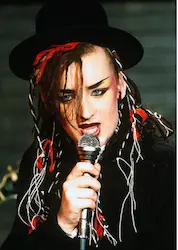
While not out as gay when a member of Culture Club, Boy George was at the vanguard of queer culture in the ‘80s with his clothing and makeup selections. With long braids, heavy eyeliner, and flamboyant hats, George created a visual language that rejected binary expectations. His exposure on MTV and other media outlets made it more ok to look and act androgynous. He kept his cool amid the harsh British media, disarming them with quips like “I prefer a cup of tea to sex”. After he came out, Boy George ramped up his support of LGBTQ causes and remains a champion of them to this day.
Marc Almond
As part of Soft Cell and as a solo artist, Marc Almond embraced flamboyance and nonconformity in action and song (e.g. Sex Dwarf). Soft Cell’s singles were favorites in the LGBTQ community, as evidenced by their play at the dance clubs were they frequented. Almond often discussed queer nightlife, making him an icon and model for queers. Almond performed at AIDs benefit concerts in the ‘80s and ‘90s, at a most crucial time. This is while most in other genres stayed silent.
Cyndi Lauper
Cyndi Lauper was an important ally in the LGBTQ cause. She founded True Colors United (taking a hit song as a branding opportunity), supporting homeless LGBTQ youth. And this song became a clarion call for expression of sexuality and was used in other LGBTQ campaigns. Finally, she politically lobbied to champion these issues, and even discussed it at the Grammys.
Cultural Impact and Legacy
These new wave artists delivered great music and entertained well. But for many gay and queer teens in the '80s, these songs weren’t just catchy - they were a lifeline, offering permission to exist and feel proud. It also allowed them to commiserate with the artists regarding their struggles to be accepted. New wave welcomed androgyny, camp, and fluid fashion. True to its subversive nature, it bypassed conservative gatekeepers and went straight to MTV and Top of the Pops, and into living rooms around the world. Queer-coded styling—eyeliner, flamboyant outfits, ambiguous gender roles - reached teens in suburbia before they even had the words for what they were seeing.
What began as subtle styling in the early '80s laid the foundation for openly queer artists in the '90s and beyond. For example:
- Erasure and the Pet Shop Boys (late '80s)
- Scissor Sisters ('00s)
- Chappell Roan ('20s)
First steps are the most important, and new wave artists were courageous in that regard. Even artists that are not openly gay, lesbian or bi embraced the aesthetic, whether it was Annie Lennox’s cropped hair and suits or the Phillip Oakey’s long hair and eyeliner. And others were allies who wrote about acceptance, like Richard Butler. Although the popular artists and songs were almost all from the US and UK, they allowed LGBTQ communities around the world to thrive.
MORE ARTICLES
B-52s: Do Call It a ComebackCyndi Lauper: Girls Just Wanna Bend TimeWomen in New Wave: Weymouth, Lauper * MoreOutro
From heartbreak ballads to glittery rebellion, new wave gave LGBTQ listeners more than just music - it gave them mirrors, mantras, and hope. Its legacy endures, not just in sound, but in the freedom it inspired. At its best, new wave wasn’t just inclusive. It was revolutionary - and it still resonates today.
A new one every month.
($8/month USD) Secure checkout with Gumroad

Just Released On Synth and Swagger:
Bands Masquerading as Other BandsHalloween Song Commentaries (2 free, 6 vault)