




Intro
New wave music and lyrics were definitely quirky compared to other styles at the time. But Oingo Boingo and Devo really pushed the envelope. For example, while the Cars judiciously added synths, their lyrics were pretty straightforward. Even the avant-garde, electro-tinged Panorama was, at its core, a straightforward song about obsession. While Oingo leaned heavily on theatrical chaos, Devo stripped it down to the mechanical precision that would make a factory jealous.
"Devo had you questioning if you are a puppet. Oingo invited you to dance in the graveyard."
Two Quirky New Wave bands Step Into a Decade…
Not all new wave weirdness came from the same emotional core. Some bands, like Devo, were influenced by Krautrock. Devo leaned heavily into that cold German influence - bands like Neu! and Kraftwerk, whose repetition and emotional detachment shaped Devo’s robotic sound and ironic tone.
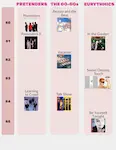
Boingo, on the other hand, drew more from the expressive, theatrical side of new wave. Think XTC’s nervous wit, Talking Heads' intellectual funk, or Thomas Dolby's synth-driven melodrama. These artists brought complexity and emotion into their weirdness—much like Boingo, who made strangeness feel human, not alien.
To understand where Boingo and Devo land on the spectrum, it helps to look at how other “intellectual weirdos” of the era handled tone and message.
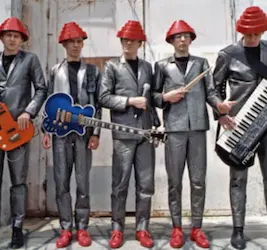
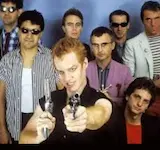
On stage, the differences sharpened. Oingo Boingo turned their concerts into carnivals - horns, costumes, and Elfman leaping like a mad ringmaster. Devo, by contrast, were mechanical and minimalist: synchronized movements, matching jumpsuits, and cold stares. One band invited you to dance in the graveyard. The other dared you to question if you were a puppet.
When I was first diving into new wave music in college, I thought Oingo Boingo was more cynical. After all, death sucks, and they focus on that, right? And Elfman is darkly eccentric, yes? And take Devo: they were overwhelmingly known for the upbeat melody of Whip It, which encourages you to tackle any problem you face head-on, and the sunny Beautiful World. But wait…
Available in the Vault

Devo’s Dystopian Cool
With nihilism and irony in their DNA, Devo literally stood for “de-evolution”, a core belief of the band well before the movie Idiocracy was made. Disenchantment with technology is a big theme with Devo. And why not? They came from Akron, Ohio, an American city that was hit hard by deindustrialization in the ‘70s. The robotic, icy repetition of their synths echoed the machinery of their hometown. Where Elfman jumps from whispers to wails like a musical theater ghost, Mothersbaugh sticks to a deadpan—cold, steady, and ironic.
Listen carefully to Beautiful World: near the end Mothersbaugh says its beautiful only for a select few. Other than a slight uptick in attitude in the vocals, the song sounds the same to the end. Talk about a curveball! The video reinforces the real meaning of the song, much to the main character’s dismay. In their third album Freedom of Choice, the song Cold War skewers the decades-long US-Soviet spat. He repeats “I owe, owe you absolutely nothing”. This is balanced out by songs that, while keeping their bleak tone, offer the listener a way out of the mess illustrated in the other songs. For example, in the album’s title track, Mothersbaugh’s mantra to the listener is to avoid being tricked and take advantage of their free will. For instance, Devo’s Puppet Boy is an anthem of defiance, as the puppet starts refusing to do his master’s bidding. The vignettes are more pointed and reinforced by the music, while Oingo Boingo offers it at a high-level and softens it musically with theatrical pomp. Devo thrives in this role—they want you to squirm, reflect, and rewire your brain.
Oingo Boingo’s Macabre Optimism
First off: they were known for theatrics. This is not surprising given frontman Elfman’s theatrical background (and film scoring that took off with 1985’s Pee-Wee’s Big Adventure). And I swear if I looked up “macabre” in the dictionary, I would be met with the mischievous grins of Elfman and the gang. In fact, the album Dead Man’s Party was a loose concept album about dealing with the afterlife and has perfect Halloween material. As I was listening to it, I realized there is a Dia de Los Muertos feel with their music. It hit me: for them, death wasn't fearsome - it was festive. For example, in the song Dead Man’s Party, Elfman is dead but pleads to his girlfriend to not be afraid, as he’s otherwise the same (though really it’s more than just a mere flesh wound). In albummate Heard Somebody Cry, Elfman says he has a soul (despite being a ghost). These and other Oingo songs have Elfman advertising that death is not something to be afraid of, but to adjust to.
And while Oingo Boingo sometimes leans into grossness (I’m looking at you, Insects), some songs are actually optimistic and progressive. For instance, Not My Slave could be seen as a call for gender equalitygender equality, as Elfman tries to convince his girlfriend to not be subservient to him. In No Spill Blood, Elfman shows to the listener that we automatically conform without knowing the backstory, which has both personal and political connotations. Also look at their pedigree: the band hails from the Los Angeles area, which has great weather and was doing well in the ‘70s.
Available in the Vault

Conclusion
So who’s better? It depends, and it’s not to be diplomatic. I prefer Oingo Boingo for their more optimistic (and strange) melodies and themes. I really admire Devo for their absurdity-infused social commentary, but I need to be in the right mood to dig them. Of course, your mileage may vary. Both are excellent bands worthy of the quirky corner of the new wave kingdom. Let it be said: Devo built walls to keep the world out, while Oingo Boingo welcomed the madness with open arms.
Finally, Oingo Boingo inspired alt-metal bands like Primus with their twisted theatricality, while Devo paved the way for irony-driven artists like They Might Be Giants, Franz Ferdinand, and Yard Act. And just like their frontmen’s bands, Danny Elfman and Mark Mothersbaugh both made the leap to Hollywood. Elfman scoring everything from Beetlejuice to Sam Raimi's version of Spider-Man, and Mothersbaugh lending his off-kilter charm to The Royal Tenenbaums, Life Aquatic, and Thor: Ragnarok.
Beyond Devo and Boingo: Soundtracks
Before they became two of Hollywood's most distinctive composers, Danny Elfman and Mark Mothersbaugh were already writing the musical DNA of their future soundtracks. Discover how Oingo Boingo and Devo quietly foreshadowed everything from gothic fantasy to gleeful cinematic chaos.Vault members unlock this and five other bonus writeups (2- to 3-minute reads)
Available in the vault Vault login
A new one every month.
($8/month USD) Secure checkout with Gumroad

Just Released On Synth and Swagger:
Bands Masquerading as Other BandsHalloween Song Commentaries (2 free, 6 vault)